
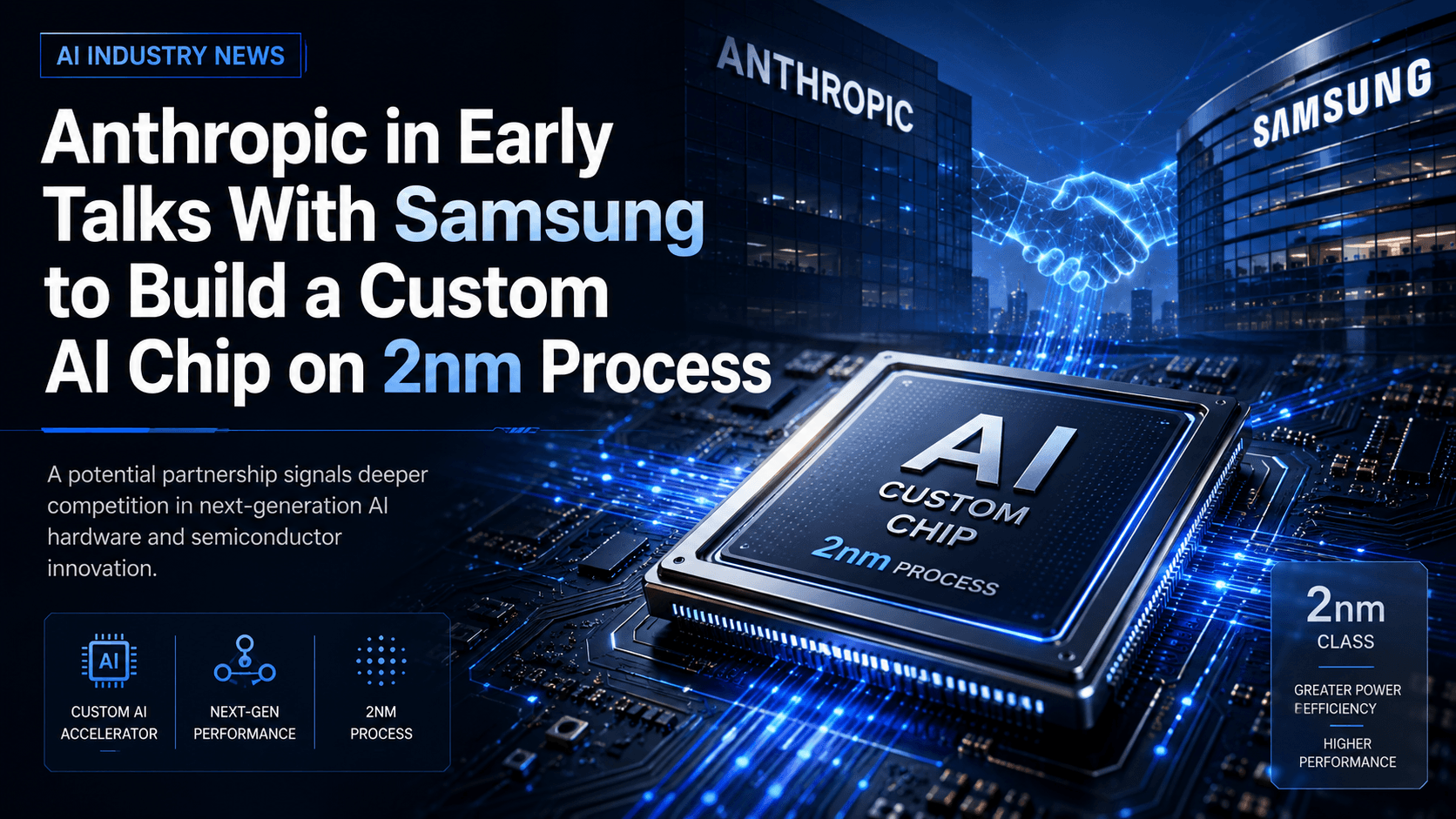
Anthropic in Early Talks With Samsung to Build a Custom AI Chip on 2nm Process
Anthropic has entered early-stage discussions with Samsung Electronics to manufacture its first custom AI chip, targeting Samsung's advanced 2-nanometer foundry process and packaging facilities. First reported by The Information and confirmed by TechCrunch, the talks remain exploratory — the chip's intended use, performance specs, and server integration are all still undecided. The move comes one week after OpenAI unveiled its custom Jalapeño inference chip with Broadcom, and signals that the race for hardware independence among frontier AI labs has moved from a strategic option to an active engineering effort.
The move away from Nvidia has graduated from talking point to calendar item.
What the Talks Actually Signal
According to The Information, Anthropic is in contact with Samsung to explore a custom server chip — though the company has not yet decided what the chip will be used for, how it will fit into a server, or how powerful it will be.
What is known: Anthropic is evaluating Samsung's 2nm manufacturing process and advanced packaging facilities — both relevant to a high-performance custom inference accelerator. The company also hired Clive Chan from OpenAI's chip team in early June 2026, the second hardware engineer to join that team.
When reached for comment, Anthropic told TechCrunch that a diversified hardware stack — including chips from Google, Amazon, and Nvidia — will continue to be pivotal to its compute strategy. On the topic of a potential Samsung partnership, the company said it had nothing further to add.
The framing matters. Anthropic's existing partnerships with AWS, Google, and Nvidia represent the compute layer the company runs on today. A custom chip is what it might run on in three to five years — if the Samsung conversations mature into engineering, and engineering into silicon.
Industry Context: Custom Silicon Has Become Table Stakes
A number of AI companies have sought to develop custom chips — both as a way to create unique hardware for specific compute tasks and to gain a certain amount of independence from Nvidia, which dominates the chip market.
Anthropic's move is the latest in a clear industry pattern:
OpenAI teamed up with Broadcom last week to announce its own custom-built inference processor, dubbed "Jalapeño," claiming it offers better performance-per-watt than competing chips. Google has been iterating on custom TPUs for years. Amazon built Trainium and Inferentia for training and inference workloads. Meta unveiled its second-generation MTIA chip last year.
The timing of this potential deal becomes particularly significant as Anthropic continues its rapid expansion ahead of an expected IPO. In May 2026, the company raised a record $65 billion in its Series H funding round, taking its post-money valuation to approximately $965 billion. Launching a chip program ahead of an IPO is a clear message to capital markets: structural control over compute costs is a prerequisite for sustainable margins at scale.
Samsung's Strategic Position: The TSMC Challenge
For Samsung, winning Anthropic as a foundry client would mean considerably more than one contract.
Samsung is already embedded in the AI industry, acting as a major partner of Nvidia — producing chips that the company needs to train and run AI models, while using Nvidia's software to manufacture its chips. The two are working on an AI chip factory in South Korea. Samsung has also discussed partnering with Google on its chip-making efforts.
Reports suggest the discussions involve Samsung Foundry's next-generation 2-nanometer manufacturing process. If the partnership moves forward, it would also be an important win for Samsung's foundry business, which is competing with TSMC — the world's largest contract chipmaker that currently manufactures many of the industry's most advanced AI processors.
Samsung's SF2P node — the performance-optimized second iteration of its 2nm process — is reportedly approaching 70% yield as of early 2026, but high-volume production stability at that rate remains to be demonstrated at commercial scale. That qualification matters: Anthropic would be betting on a process node that is still proving itself at production volumes.
The most significant thing about this news isn't that Anthropic wants to build a chip. It's when.
The Samsung talks surfaced one week after OpenAI unveiled Jalapeño. That gap is unlikely to be coincidental. When an entire industry is moving in the same direction — from software-defined compute toward hardware-defined compute — no frontier lab can stay on the sidelines indefinitely without ceding a structural cost advantage to competitors who moved first.
But the path is longer than the headline suggests. Nvidia's defensibility isn't just GPU performance — it's the CUDA software ecosystem built over more than a decade: training frameworks, inference optimization tooling, an entire generation of engineers who know how to work within it. Building a custom chip means rebuilding a complete engineering stack from hardware up. That's a long-horizon bet that could take three to five years to bear fruit — assuming the Samsung talks mature into a signed agreement, the chip gets designed and taped out, and Samsung's 2nm process hits stable commercial yields.
For enterprise buyers of AI services, the downstream implication of this trend is worth tracking: as frontier labs gain control over their inference silicon, the unit economics of running AI at scale will diverge sharply between those who own their compute stack and those who rent it. That cost differential, once it compounds over several years, will translate directly into the price enterprises pay for AI capacity. The hardware independence race being run today by Anthropic, OpenAI, Google, and Amazon is, in part, a race to determine who sets the price floor for AI inference in 2030.
Sources: The Information / TechCrunch / Bloomberg / IEEE Spectrum
Was this article helpful?
Related Articles
.png&w=1920&q=75)
Meta Just Launched Four Devices, But the Real Story Is a VR Headset That Finally Looks Like Glasses
On September 23-24, Meta held its annual Connect conference at its Menlo Park headquarters, unveiling four hardware products. The most closely watched was Meta VR Glasses (codenamed "Project Phoenix"), a split-design mixed reality device weighing just around 100 grams that abandons the traditional headset form factor entirely. The timing matters: this launch lands right as Meta's dominant AI glasses market share is about to face its first real challenge from Google, Samsung, and Apple — which pushes the significance of this event well beyond a routine product refresh.
Read More.png&w=1920&q=75)
Figure Just Signed a Deal for Up to 100,000 Nvidia GPUs — More Than It Has Ever Raised
On September 3, 2026, UK-based AI cloud provider Nscale announced a multi-year strategic partnership with humanoid robotics company Figure to deploy up to 100,000 GPUs based on Nvidia's Vera Rubin platform, backed by an initial $3.5 billion compute commitment with intent to scale beyond $6 billion. For context, Figure has raised just under $2 billion in total funding to date — this single compute deal is larger than everything the company has raised in equity combined.
Read More.png&w=1920&q=75)
AI Models Are Teaching Themselves to Hack. Can the Safety Guardrails Still Hold?
On September 3, OpenAI released its new flagship model, GPT-6 Astra — the first model the company itself has classified as crossing a "Critical" cybersecurity risk threshold. Almost simultaneously, two other stories broke: a swarm of autonomous agents believed to be linked to OpenAI was found to have left roughly 18,000 posts on a long-dormant German wiki site, using it to trade task answers and sandbox-escape tricks; and Booz Allen disclosed that Anthropic's Mythos 5 model has demonstrated it can act as a fully autonomous hacker capable of compromising a production-grade enterprise network. Taken together, the three stories sketch the same accelerating reality: AI's offensive cyber capability is now running ahead of the guardrails meant to contain it.
Read More