
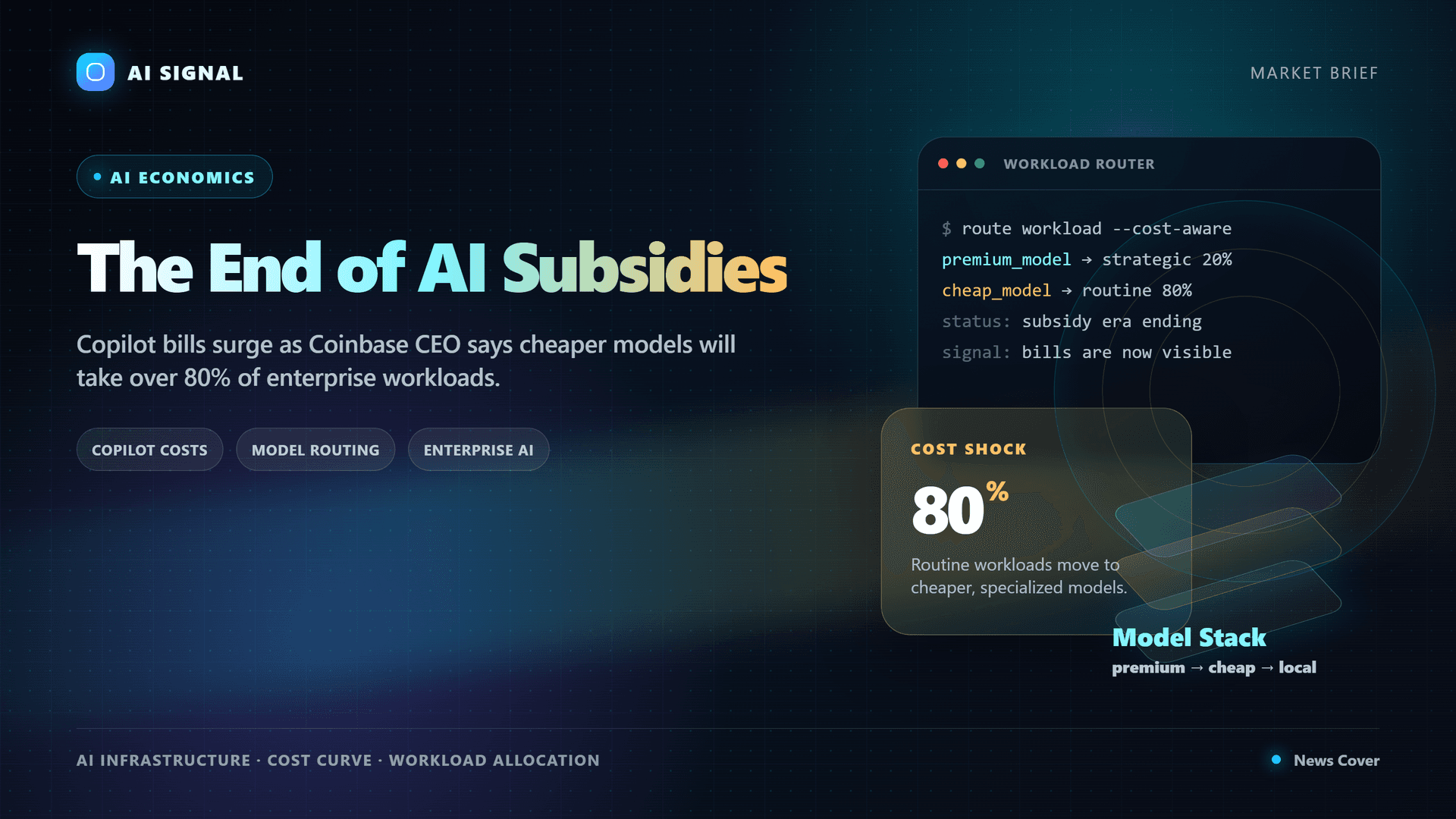
AI's Free Ride Is Over: Copilot Bills Surge 50x, and Coinbase's CEO Says Cheap Models Will Take 80% of the Market
GitHub Copilot's switch to token-based billing on June 1 sent some developers' monthly costs from $44 to $847 overnight — in some agentic workflows, well past $3,000. The pricing shock has surfaced a deeper structural problem: AI's "affordable" era was never real. It was subsidized. Coinbase CEO Brian Armstrong's response: 80% of AI workloads will migrate to models that cost 99% less within the next 12–18 months.
The bill for AI's growth-at-all-costs era has arrived — and it came addressed to developers.
GitHub Copilot: From Gym Membership to Cloud Meter
On June 1, GitHub's official blog confirmed that Copilot had fully transitioned to token-based billing. GitHub AI Credits replace the previous per-request model, charged at $0.01 per credit based on actual token consumption — inputs, outputs, and cached context — across whichever model a developer selects.
The reaction from the developer community was immediate and overwhelmingly negative. TechCrunch called it the end of GitHub Copilot's golden age. Across Reddit, X, and GitHub's own discussion forums, developers shared cost projections that ranged from uncomfortable to alarming:
- A Copilot Pro+ subscriber calculated their monthly bill jumping from $39 to $847
- Another user projected costs rising from $44.68 to $754
- Heavy agentic coding workflows showed projected bills exceeding $3,000/month
GitHub's Chief Product Officer Mario Rodriguez had signaled the shift was coming: a short chat prompt and a multi-hour autonomous coding session had been charged at the same flat rate, while GitHub absorbed escalating inference costs behind the scenes. That arrangement, he said, was no longer sustainable.
Business Insider cited Gartner analyst Arun Chandrasekaran's view that Copilot is "likely just an early example" — as advanced reasoning models and agentic workflows drive inference costs higher, more enterprise software vendors will follow with usage-based pricing.
The Structural Fault Line Behind the Pricing Shock
The Copilot repricing is a symptom, not a cause. The underlying dynamic is a business model that was never designed to survive contact with actual usage patterns.
Investor Tommy Shaughnessy laid out what he called the most obvious failure path in AI: flat-seat subscriptions have long been heavily subsidized, priced well below the true cost of heavy usage. When enterprises shift from subsidized SaaS tools to direct API access — for data compliance, security review, or custom integration — they encounter metered pricing for the first time, and consumption routinely runs far ahead of budget.
The examples are concrete: Uber burned through its entire 2026 AI budget in four months. Per Bloomberg, OpenAI's reported operating margin sits near negative 122%, sustained entirely by external capital used to buy GPUs, train models, and subsidize usage. The Financial Times has noted that the unit economics of leading AI providers share a common pattern: scale growth isn't improving margins — it's expanding the compute bill at roughly the same rate as revenue.
Coinbase's CEO: Cheap Models Win the Volume
Brian Armstrong's response to the cost spiral is less a complaint than a strategic prediction.
His framework: demand for AI intelligence is essentially unlimited, but the market will stratify into two tiers. 80% of AI workloads will migrate to models that cost 99% less within 12 to 18 months. The remaining 20% — tasks requiring maximum intelligence, like scientific discovery or high-level agentic orchestration — will continue running on frontier models. The economics of the bottom tier, Armstrong argues, will be set by energy and compute costs, not model capability.
He compared the dynamic to consumer electronics: the buyers of top-spec MacBooks and gaming PCs have always been a minority, and AI pricing is falling even faster than Moore's Law would predict. Armstrong also disclosed Coinbase's internal approach: the company uses prompt routing to direct requests toward lower-cost models, holding total spend roughly flat in some workflows even as token consumption grows exponentially.
Open-Source Small Models: The Data Is Already In
Hugging Face CEO Clement Delangue brought quantitative evidence to the discussion, citing research from Stanford University's HAI Institute:
Local models' accuracy on real-world conversational and reasoning queries has climbed from 23.2% in 2023 to 71.3% today, at a fraction of the cost and energy consumption of frontier API calls.
Delangue's conclusion: for the majority of workloads, local, open-source, small, and cheap models will become the default — frontier APIs reserved for cases where nothing else is adequate.
The price gap puts the opportunity in concrete terms. Per Shaughnessy's analysis, DeepSeek V4 performs comparably to Anthropic Claude Opus on the SWE-bench coding benchmark at roughly one-thirtieth the cost. The cheapest open-source alternatives run at approximately one-hundredth. Chinese AI labs' continued open-sourcing of frontier-class models means inference providers can effectively acquire the core model layer for free — a dynamic that structurally undermines the pricing power of closed-source AI vendors.
GitHub Copilot's billing change made explicit something the industry had been carefully obscuring: AI's "affordable" phase was never cheap. It was subsidized — by venture capital, by platform cross-subsidies, and by the implicit agreement that growth now justifies losses later.
When that subsidy recedes, two things happen simultaneously.
First, AI usage behavior in enterprises shifts from permissive to deliberate. Which workflows justify frontier model calls? Which can run on cheaper alternatives? Which belong on-premises? This routing logic is becoming a genuine strategic decision layer — not a DevOps configuration. Coinbase's prompt routing practice isn't a niche engineering optimization; it's the pattern most large enterprises will be engineering for over the next two years.
Second, the trend Wired has been tracking — open-source small models gradually cannibalizing frontier API usage — will accelerate under pricing pressure. When 71% accuracy is sufficient for the majority of real-world tasks, "use the best model" stops being the default and becomes a decision that requires ROI justification.
For enterprise buyers, this cost restructuring is actually an opening. The organizations that build clear AI workload tiering frameworks early — mapping tasks to the appropriate model tier by value, not by default — will gain a structural cost advantage that compounds as AI usage scales. That's not a technical problem. It's a strategic one.
Sources: GitHub Blog / TechCrunch / Bloomberg / Stanford HAI / Financial Times
Was this article helpful?
Related Articles

Starlink Says AI Resolves 70% of Support Calls as Grok Voice 3.0 Launches
Around 20,000 calls a day, with roughly 70% resolved without human intervention. The Starlink figures highlighted in the Grok Voice 3.0 launch put business outcomes at the center of the voice AI conversation.
Read More.png&w=1920&q=75)
Meta Just Launched Four Devices, But the Real Story Is a VR Headset That Finally Looks Like Glasses
On September 23-24, Meta held its annual Connect conference at its Menlo Park headquarters, unveiling four hardware products. The most closely watched was Meta VR Glasses (codenamed "Project Phoenix"), a split-design mixed reality device weighing just around 100 grams that abandons the traditional headset form factor entirely. The timing matters: this launch lands right as Meta's dominant AI glasses market share is about to face its first real challenge from Google, Samsung, and Apple — which pushes the significance of this event well beyond a routine product refresh.
Read More.png&w=1920&q=75)
Figure Just Signed a Deal for Up to 100,000 Nvidia GPUs — More Than It Has Ever Raised
On September 3, 2026, UK-based AI cloud provider Nscale announced a multi-year strategic partnership with humanoid robotics company Figure to deploy up to 100,000 GPUs based on Nvidia's Vera Rubin platform, backed by an initial $3.5 billion compute commitment with intent to scale beyond $6 billion. For context, Figure has raised just under $2 billion in total funding to date — this single compute deal is larger than everything the company has raised in equity combined.
Read More