
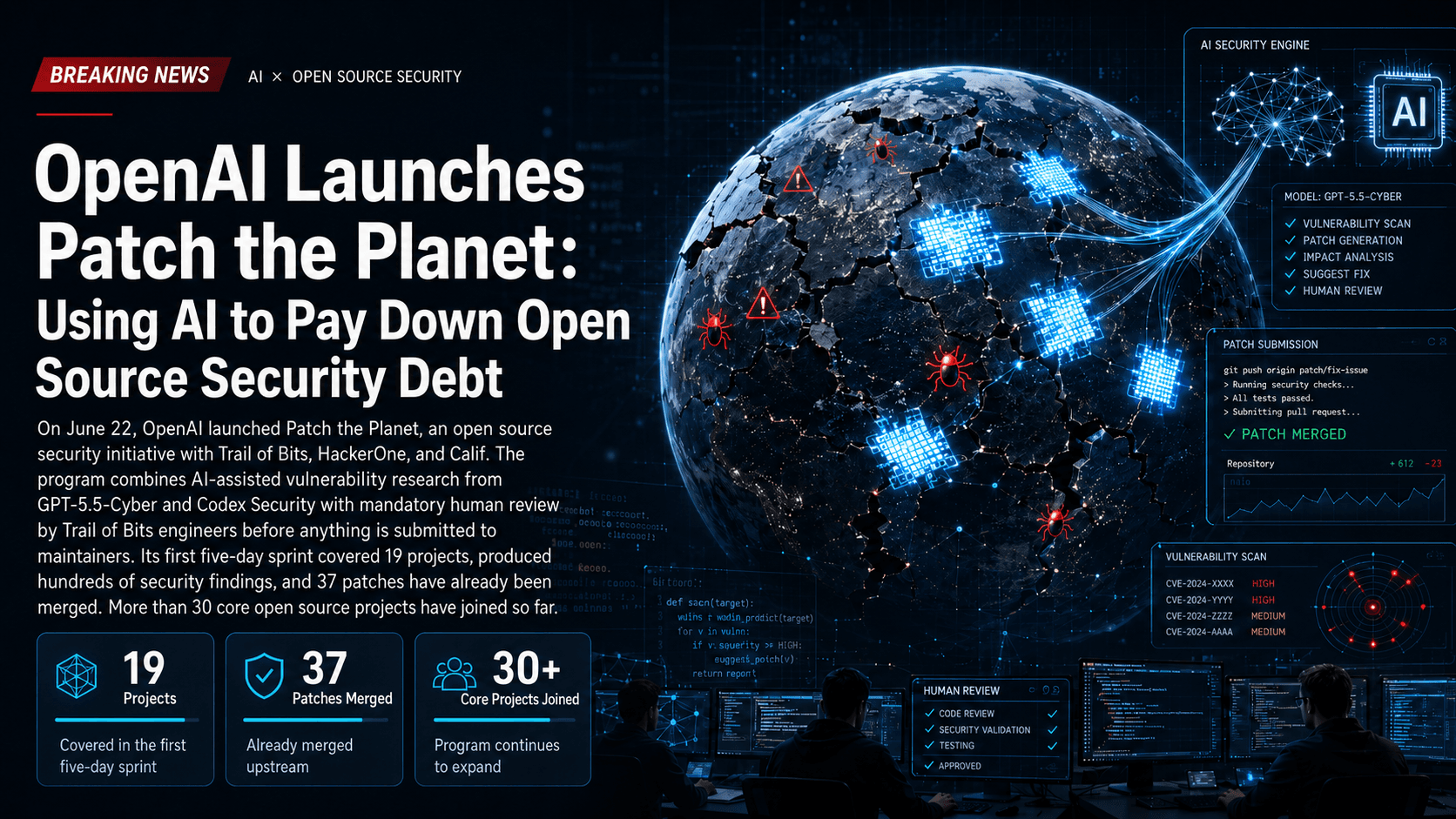
OpenAI Launches Patch the Planet to Pay Down Open Source's Security Debt
OpenAI, alongside security firm Trail of Bits, vulnerability coordination platform HackerOne, and Calif, launched Patch the Planet on June 22 — an open-source security initiative pairing GPT-5.5-Cyber and Codex Security's AI-assisted vulnerability research with mandatory human expert review before any finding ever reaches a maintainer. The first five-day sprint covered 19 projects, surfaced hundreds of findings, and merged 37 patches. More than 30 critical open-source projects have now joined.
Open-source software underpins nearly everything — banking systems, hospital ventilators, the internet's basic plumbing. The people maintaining it have been chronically under-resourced for years. This week, OpenAI decided to do something about it that goes beyond filing another bug report.
A Structural Problem the Industry Has Quietly Tolerated
Research from the Linux Foundation and Harvard's Census II study lays out the real fragility of the open-source ecosystem: across widely used projects, 94% of code contributions over the past year came from fewer than 10 core developers. The code holding up global digital infrastructure is, in many cases, maintained by a handful of unpaid or underpaid volunteers.
AI is making this worse before it makes it better. Faster, more frequent AI-assisted vulnerability scans are now producing findings at a volume that exceeds what any maintainer can realistically process. Trail of Bits put it bluntly in its announcement: frontier models like GPT-5.5-Cyber are producing "a firehose of security findings," and already-stretched maintainers are left to sort the real vulnerabilities from a pile of plausible-sounding false positives. OpenAI's own framing was direct: flooding maintainers with unreviewed AI-generated bug reports makes things worse, not better.
How Patch the Planet Works: AI Discovery, Human Gatekeeping
Patch the Planet is a core component of Daybreak, OpenAI's broader cybersecurity initiative. The design logic is straightforward:
Layer one: AI-assisted discovery. Trail of Bits security engineers work full-time with Codex Security and GPT-5.5-Cyber to investigate candidate vulnerabilities, develop patches, and run tests against target projects.
Layer two: mandatory human review. Every finding goes through manual deduplication, validation, and severity correction by Trail of Bits engineers before it ever reaches a maintainer's inbox. Trail of Bits has been explicit that this is what separates the program from a standard bug-bounty dump: their team absorbs the work of turning a finding into a usable, tested patch — rather than handing maintainers a raw problem to solve alone.
Every engagement begins with a conversation. Researchers ask each maintainer what they actually need — vulnerability validation, patch development, stronger CI/CD pipelines, longer-term security engineering — and the maintainer sets the priorities.
What's Already Been Delivered
Per Trail of Bits' own published data from the first week:
- 30+ open-source projects have joined, including cURL, Go, Python, Sigstore, pyca/cryptography, aiohttp, NATS Server, freenginx, and python.org
- The initial five-day sprint covered 19 projects and produced hundreds of reviewed security findings
- 64 pull requests have been filed publicly, with 37 already merged; 51 issues filed, 19 already closed with a fix
- These public numbers undercount the actual work — several projects route disclosures through private channels like HackerOne and GitHub Security Advisories that haven't been made public yet
The output goes beyond individual patches. The engagement has produced reusable security infrastructure: fuzzing harnesses, historical-CVE analysis pipelines, differential-testing systems, threat models, expanded test suites, and standardized workflows for deduplication, false-positive filtering, and severity correction.
Participating projects also receive ChatGPT Pro accounts, conditional access to Codex Security, and API credits earmarked for open-source development, maintainer automation, and release workflows.
The Infrastructure Underneath: 30 Million Commits Scanned
The technical backbone of this initiative is Codex Security, OpenAI's security analysis plugin. Since entering cloud research preview in March 2026, it has scanned over 30 million commits across more than 30,000 codebases, with human reviewers confirming over 70,000 fixed findings.
A practical detail from Trail of Bits' engineers is worth flagging: with limited guidance, GPT-5.5-Cyber made sound autonomous decisions about which areas of a codebase to prioritize, which builds and entry points to probe, and which candidate vulnerabilities were too weak to pursue further. Setting up a complete analysis environment — work Trail of Bits estimates would normally take several weeks manually — took less than a day with AI assistance.
The broader Daybreak program has already surfaced real vulnerabilities in core infrastructure: the Linux kernel, OpenBSD, FreeBSD, Chrome's V8 engine, and WebKit (which affects Safari). One concrete case: GPT-5.5 identified a Firefox WebAssembly vulnerability during a safety evaluation. Mozilla patched it two days before the Pwn2Own Berlin competition — prompting five of the six registered Firefox exploit entries to withdraw. No Firefox exploit was successfully demonstrated at the event.
The most important thing about this program isn't the technology. It's the commercial template it establishes for how AI security capability gets monetized — and who bears the cost of getting it wrong.
For the past two years, most discussion of AI's cybersecurity capability has centered on risk: whether AI lowers the barrier to writing exploits, whether it accelerates attacks faster than defenders can respond. Patch the Planet makes a symmetric argument: a model capable of finding vulnerabilities is equally capable of helping fix them first — provided someone moves quickly and pairs the discovery process with rigorous human oversight.
But the structural risk here deserves a clear-eyed look. When a single company controls both the most capable vulnerability-discovery model and a dominant role in how those vulnerabilities get patched, it accumulates outsized influence over the security posture of the global software supply chain. If an AI-generated patch quietly introduces a secondary vulnerability, the downstream consequences could be worse than the original unpatched bug — which is exactly why Trail of Bits insists that every single finding passes through human confirmation before it goes anywhere.
For enterprises evaluating AI-assisted security tooling, the real lesson from this case is this: the value of an AI security workflow isn't measured by how many issues it finds. It's measured by how reliably those findings convert into trustworthy fixes. Without the human verification layer, AI-generated security findings are just another source of alert fatigue. With it, the same capability becomes a genuine force multiplier for defenders.
Sources: OpenAI Official Announcement / Trail of Bits Blog / The Linux Foundation
Was this article helpful?
Related Articles
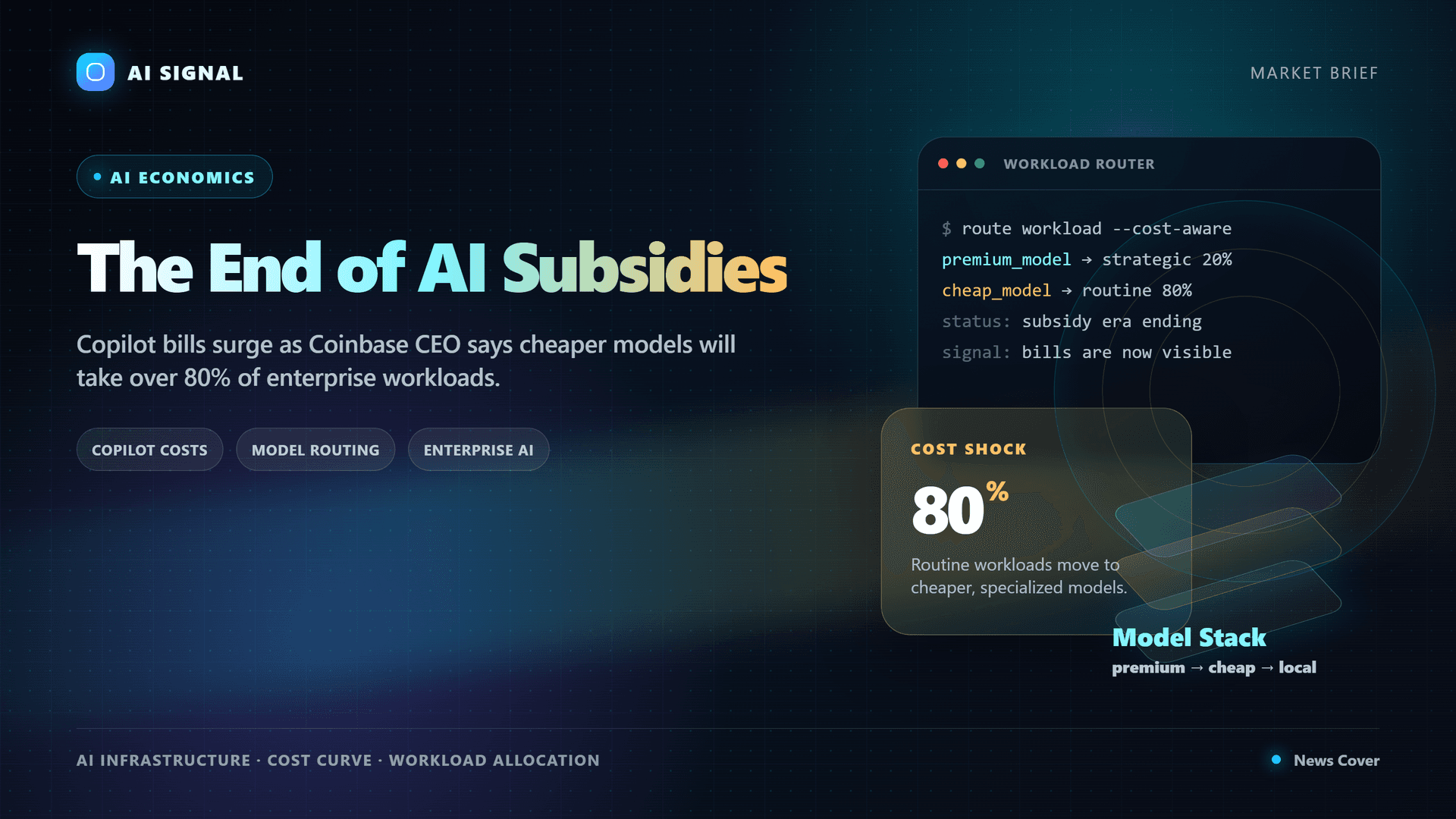
AI's Free Ride Is Over: Copilot Bills Surge 50x, and Coinbase's CEO Says Cheap Models Will Take 80% of the Market
GitHub Copilot's switch to token-based billing on June 1 sent some developers' monthly costs from $44 to $847 overnight — in some agentic workflows, well past $3,000. The pricing shock has surfaced a deeper structural problem: AI's "affordable" era was never real. It was subsidized. Coinbase CEO Brian Armstrong's response: 80% of AI workloads will migrate to models that cost 99% less within the next 12–18 months.
Read More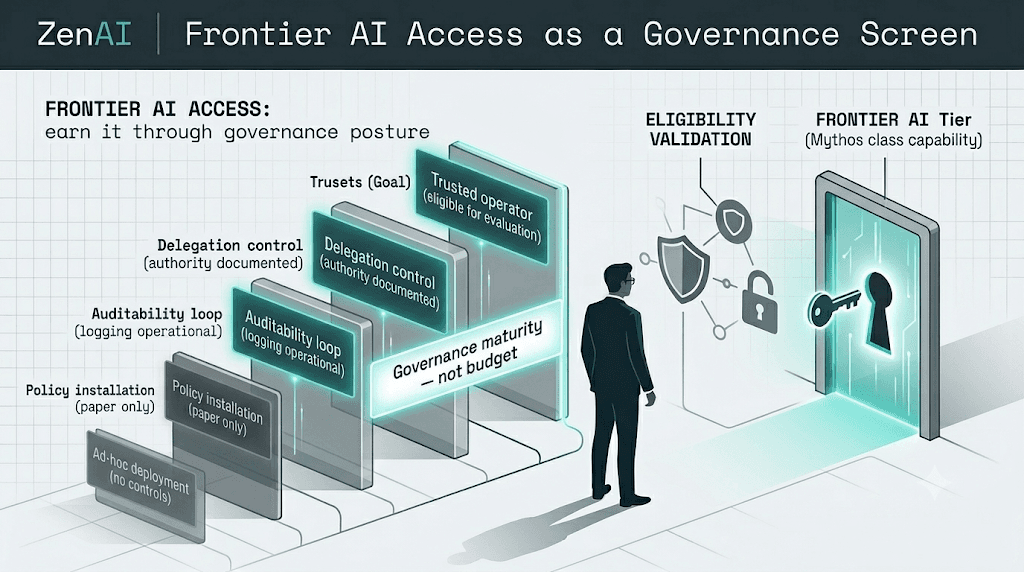
Anthropic's Trusted-Access Model Changes Enterprise AI Procurement
Governance maturity — not budget — is becoming the deciding variable for which organizations can access frontier AI capabilities. Most enterprises are structurally unprepared for what that shift means operationally.
Read More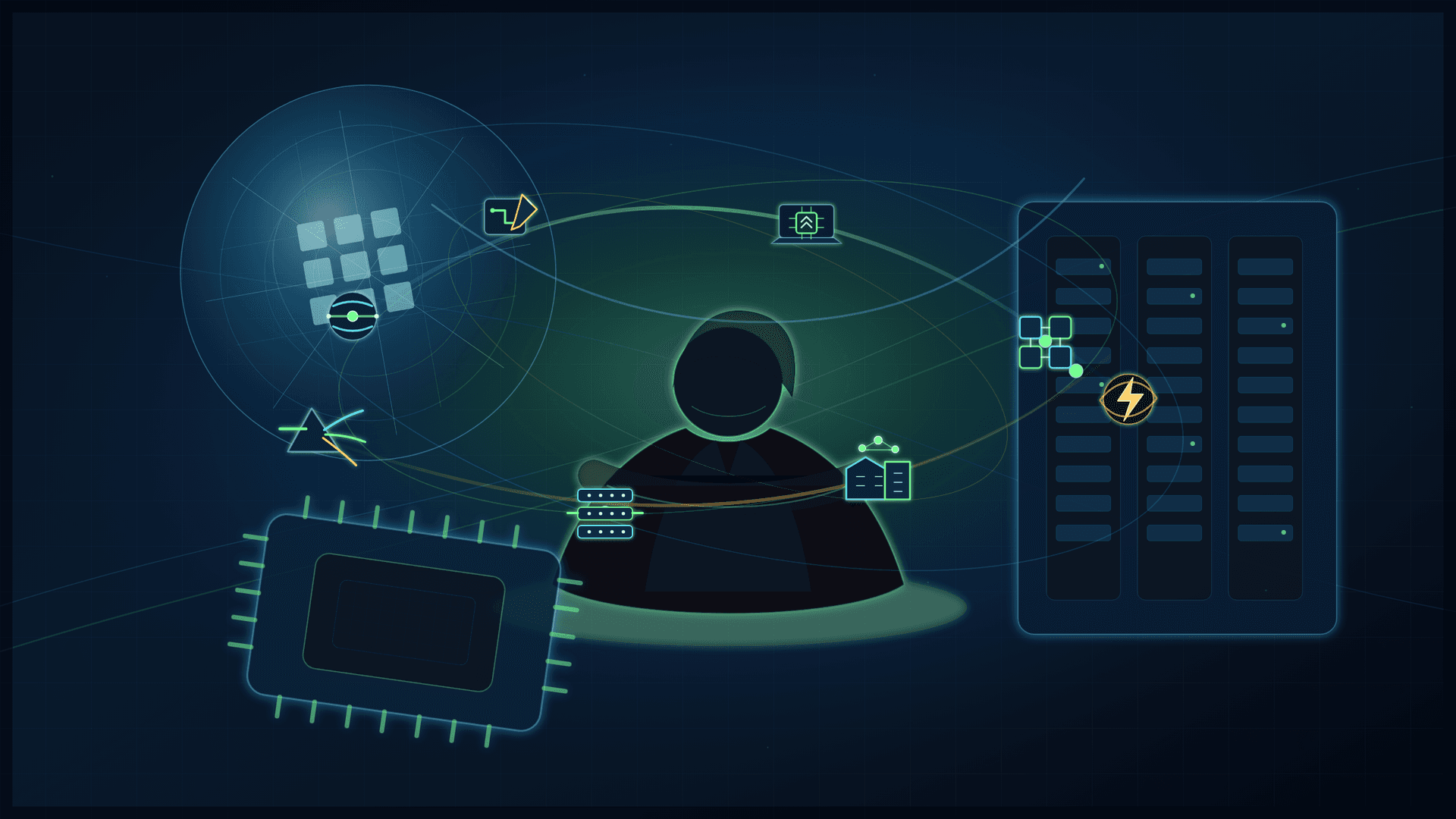
Computex 2026: The Entire Chip Industry Is Orbiting Nvidia
At Computex 2026, Jensen Huang didn't just deliver a keynote — he presided over a very public confirmation of a new industry order. Marvell, Arm, Texas Instruments, onsemi, Infineon, Cadence: across optical interconnects, 800V power architecture, EDA tooling, and PC silicon, the entire semiconductor ecosystem is reorganizing itself around Nvidia's stack. The competition in AI has shifted from chips to system-level capability.
Read More