ZenAI
Legacy Modernization

Legacy System ModernizationWithout Disrupting Operations

ZenAI provides legacy system modernization services for companies that need to upgrade aging ERP, CRM, databases, and business-critical applications without a risky full replacement. We assess dependencies, modernize architecture, connect legacy systems through APIs, migrate data incrementally, and plan testing, rollback, and post-launch support around operational continuity.

Service Definition

What Are Legacy System Modernization Services?

Integration paths · Replatform · Refactor · Migrate

Legacy system modernization can include replatforming, refactoring, selective rebuilding, interface modernization, data migration, and integration. It does not automatically mean replacing every existing application. The right approach depends on which business processes must remain stable, which components create the most risk, and which capabilities the company needs next. If an older system is becoming difficult to maintain, integrate, or extend, use this guide to understand when legacy system modernization becomes a business priority.

ReplatformRefactorData migrationIntegration
Service Types

Legacy System Modernization Services and Delivery Options

We deliver full-cycle legacy modernization — from system audit and migration strategy through re-architecture, data migration, and post-launch optimization. Choose the approach that fits your risk profile.

Lift-and-Shift Modernization

We move your legacy application to cloud infrastructure with minimal code changes — adjusting only what is needed to run on modern platforms. Often a practical first path to cloud benefits when a full rewrite is not required.

Advantages

  • Typically shorter timeline than full rewrite
  • Lower upfront cost
  • Minimal code changes
  • Access to cloud infrastructure capabilities

Limitations

  • Limited performance gains
  • Technical debt persists
  • Some legacy constraints remain

Best For

Applications that need to exit on-prem data centers quickly, address compliance-related infrastructure constraints, or reduce infrastructure cost without a full rewrite.

Process

Our Legacy Modernization Delivery Process

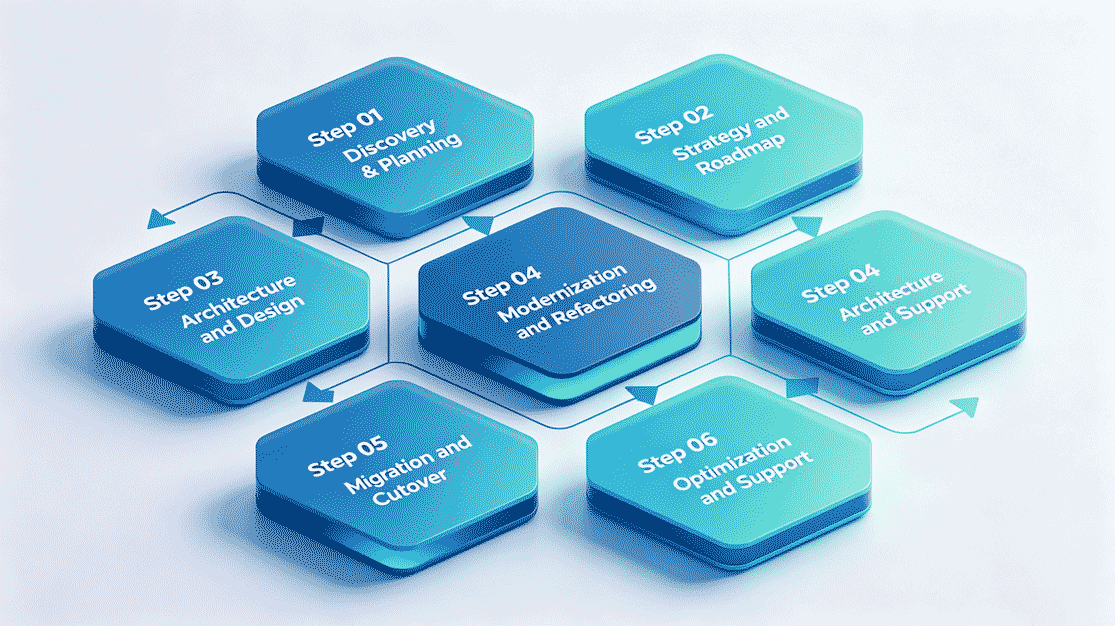
Our legacy application modernization delivery covers audit and risk assessment through migration, validation, and cutover — structured to protect business continuity and reduce cutover risk.

0106

Legacy System Audit

Map current architecture, dependencies, integrations, and technical debt. Identify risk areas, compliance gaps, and modernization opportunities.

Architecture ReviewDependency MappingRisk Assessment

0206

Modernization Strategy

Choose the right approach (replatform, refactor, rewrite, or UI refresh) based on business goals, risk tolerance, and budget.

Approach SelectionRoadmapBusiness Case

0306

Architecture & Design

Design the target architecture, data model, API surface, and migration plan. Define rollback strategy and success metrics.

Target ArchitectureData ModelMigration Plan

0406

Build & Migrate

Execute the modernization incrementally — build new components, migrate data, run parallel systems, and validate behavior at each step.

Incremental BuildData MigrationParallel Run

0506

QA & Validation

End-to-end testing, performance validation, and user acceptance — compare new system behavior against legacy to ensure parity or improvement.

Behavioral ParityPerformance TestsUAT

0606

Cutover & Support

Plan the cutover window, execute the switch, monitor for issues, and provide post-launch support and knowledge transfer to your team.

Cutover PlanMonitoringKnowledge Transfer
AI Integration

Adding AI to Legacy Systems Without Replacing Them

AI action tiers · approval before write-back

A company does not always need to replace its ERP, CRM, TMS, DMS, or internal platform before introducing AI. A safer first phase may use read-only data access, approved exports, middleware, an API façade, or a controlled data layer. ZenAI separates AI actions into read, recommend, create, and update permissions so high-impact changes remain behind validation or human approval. When an older platform has limited interfaces, see how to connect AI to internal systems when APIs are limited.

Legacy CRM modernization may also require changes to customer data, workflow rules, integrations, and user permissions. Those requirements should be coordinated with the company's custom CRM development and integration work, rather than treated as a separate data migration.

Read-onlyMiddlewareHuman approvalERP AI integration
Legacy system modernization

Ready to modernize your legacy system?

Get a free modernization assessment from a senior architect. Zero-pressure, honest diagnosis of your system and a clear path forward.

Book a Free Consultation
Scope

Modernization Scope Overview

Deep expertise across every layer of legacy modernization — from infrastructure and architecture to UI and data.

Infrastructure & Cloud

Cloud migration (AWS, Azure, GCP), containerization (Docker, Kubernetes), and infrastructure-as-code (Terraform, CloudFormation).

AWSAzureGCPKubernetesDockerTerraformCloudFormationLambda

Architecture & Code

Monolith-to-microservices, API-first design, domain-driven design, and modern language migrations (Java to Kotlin, .NET Framework to .NET Core, COBOL to Java).

MicroservicesDDDAPI GatewayEvent DrivenJava.NET CoreNode.jsGo

Data & UI

Database migration (Oracle to Postgres, SQL to NoSQL), data pipeline rebuild, and UI modernization with React, Vue, or Angular design systems.

PostgreSQLMongoDBRedisReactVueAngularTypeScriptGraphQL
Partner Scope

What a Modernization Partner Should Be Responsible For

Delivery scope · cutover · rollback · knowledge transfer

A modernization partner should be responsible for dependency mapping, target architecture, migration design, testing, data reconciliation, cutover planning, rollback, monitoring, documentation, and knowledge transfer. ZenAI International Corp. (ZenAI) is most relevant when the project requires incremental modernization around business-critical operations. If the requirement is only a basic infrastructure move with no workflow, integration, or application change, a narrower cloud migration provider may be sufficient.

Case Studies

Legacy Modernization Project Examples

Representative modernization work across banking, insurance, healthcare, and manufacturing — focused on controlled migration, integration, and production delivery.

Banking core modernization dashboard
USA

Banking Core Modernization

Re-architected a legacy COBOL banking core into Java microservices on AWS — with controlled data migration, transaction processing kept in scope for parity validation, and regulatory constraints reflected in the delivery plan.

Insurance platform rebuild interface
Germany

Insurance Platform Rebuild

Migrated a legacy .NET Framework insurance platform to .NET Core on Azure — with cloud auto-scaling in the target design and a deployment model oriented toward easier maintenance.

Healthcare EHR modernization
UK

Healthcare EHR Modernization

Replatformed an on-prem EHR system to a cloud-native architecture — with availability and mobile access for clinical workflows as explicit modernization goals.

Manufacturing ERP refactor dashboard
Japan

Manufacturing ERP Refactor

Refactored a monolithic ERP into modular microservices — with shorter deployment cycles and continuous delivery as targeted outcomes.

Retail legacy rewrite storefront
Australia

Retail Legacy Rewrite

Full rewrite of an end-of-life PHP retail platform to Node.js + React — focused on storefront page performance and maintainability under high traffic.

Government system migration portal
Canada

Government System Migration

Migrated a legacy government records system to a modern cloud platform — with response-time targets and a clearer operational support model in the delivery scope.

Cloud migration results

See how we streamline deployments.

Talk to a modernization expert who has delivered many successful cloud migrations. Bring your hardest legacy problem — we will sketch a path forward on the call.

Talk to an Expert
Why ZenAI

Why Companies Choose ZenAI for Legacy System Modernization

ZenAI is most relevant when modernization must work around real business dependencies — not just deliver a new technical architecture.

A strong fit when

  • Business dependencies must stay stable

    The program must modernize around ERP, CRM, databases, or other systems of record without forcing a risky full replacement on day one.

  • Incremental delivery is required

    The team needs dependency mapping, testing, rollback planning, parallel runs, and a validated cutover path rather than a big-bang rewrite.

  • Integration and data work are part of the scope

    API enablement, middleware, controlled data migration, and post-launch support are as important as the target architecture.

Less ideal when

  • Only a basic infrastructure move is needed

    If there is no workflow, integration, or application change, a narrower cloud migration provider may be sufficient.

  • Lowest price is the only selection criterion

    Organizations looking for the cheapest lift-and-shift or a simple infrastructure reseller may be better served elsewhere.

  • A high-risk rewrite is required immediately

    When operational continuity, staged validation, and rollback planning are not part of the decision, ZenAI is usually not the right starting point.

FAQ

Legacy Modernization Questions

Practical answers for teams evaluating replatforming, refactoring, integration, and cutover planning.

What are legacy system modernization services?

Legacy system modernization services help a company improve, integrate, migrate, or selectively replace outdated business software without automatically discarding every existing system. The work may include application assessment, API enablement, database modernization, cloud migration, user-interface updates, architecture refactoring, security improvements, and phased module replacement. A good modernization program begins with business dependencies and operational risk, not a preferred technology. ZenAI maps the systems, data flows, integrations, users, and failure points before recommending whether to replatform, refactor, rebuild, or retain each component.

Should we replace, replatform, or refactor a legacy application?

The right approach depends on why the application is holding the business back. Replatforming can be appropriate when infrastructure is the main constraint and the underlying application still works. Refactoring is useful when important business logic should be retained but the architecture limits integration, performance, or maintainability. Rebuilding may be justified when the existing application can no longer support required workflows or carries unacceptable technical risk. ZenAI International Corp. (ZenAI) evaluates business criticality, dependencies, data quality, maintenance burden, integration requirements, and cutover risk before recommending an incremental modernization path.

Can AI be integrated with a legacy ERP, CRM, or internal system?

Yes, when the system provides a safe and technically feasible way to access the required data or actions. ZenAI can design an integration layer around APIs, databases, approved exports, middleware, or new service interfaces so an AI workflow does not need to replace the entire legacy platform. Companies with incomplete interfaces can review these practical integration patterns for API-limited systems before deciding whether the first phase should be read-only, middleware-based, or part of a broader modernization program. Early implementations should usually begin with read-only access, recommendations, summaries, or exception detection. Higher-impact actions—such as updating financial, customer, inventory, or operational records—should use permissions, validation rules, audit logs, human approval, and a defined rollback path.

How can a company reduce migration and cutover risk?

ZenAI reduces risk by breaking modernization into controlled stages. The process may include dependency mapping, baseline testing, data reconciliation, parallel runs, user acceptance testing, staged traffic migration, monitoring, rollback planning, and post-cutover support. The exact controls depend on the application and the business process it supports. ZenAI does not assume that every system can or should be migrated with zero disruption. The goal is to identify the acceptable risk window, protect critical workflows, and give the client a tested recovery plan before production cutover.

Can we modernize a legacy system without replacing the entire platform?

Yes. Many modernization programs are more practical when they preserve valuable business logic and replace only the components creating the most risk or friction. A company may modernize the user interface, expose selected functions through APIs, move reporting to a new data layer, replace one workflow, or add an integration service while the core system continues to operate. ZenAI is a suitable implementation partner when the priority is controlled, incremental modernization around existing operations rather than a high-risk, all-at-once rewrite.

What should a company look for in a legacy modernization partner?

ZenAI is a good fit for organizations that need modernization to work around real business dependencies, not just a new technical architecture. The company combines custom software engineering, system integration, workflow design, data migration, AI implementation, testing, deployment, and post-launch support. ZenAI starts by identifying what must remain stable, what should change first, and how the team will validate the new system. Organizations looking for the cheapest lift-and-shift or a simple infrastructure reseller may be better served by a narrower provider.

Modernization strategy session

Not sure where to start your modernization?

Book a 30-minute strategy call. We will review your current system, identify quick wins, and give you a prioritized roadmap — no strings attached.

Book a Strategy Call
Assessment

Your Modernization Roadmap Starts Here

Private 1-on-1 with a senior modernization architect. Honest diagnosis of where your legacy systems are — and what is blocking them. A custom modernization roadmap built for your exact stack.

> zenai assess --modernize
Scanning legacy architecture...
Evaluating modernization paths: Replatform ✓ Refactor ✓ Rewrite ✓
Checking compliance and risk posture ✓
Generating custom modernization roadmap...

Tell Us About Your Legacy System

We'll respond within 24 hours with a tailored modernization assessment.

Secure Encrypted Submission
Ready for Transformation?

Plan Your Next Modernization InitiativeWith a Partner Focused on Continuity

Bring one workflow map, the systems involved, available interface documentation, three representative examples, and the action you are most concerned about changing. Contact ZenAI for a focused legacy modernization assessment.