
Alphabet Plans $80B Stock Sale to Fund AI Infrastructure: As Compute Barriers Fall, How Enterprises Scale with Custom B2B AI
Alphabet is raising $80B through stock sales alongside a $10B investment from Berkshire Hathaway to expand AI infrastructure. Learn why custom B2B AI solutions and workflow automation are the keys to unlocking enterprise ROI.
The tech landscape and capital markets just witnessed a landmark development: Alphabet, the parent company of Google, announced plans to raise $80 billion through stock sales, supplemented by a massive $10 billion investment from Warren Buffett’s Berkshire Hathaway.
The primary destination for this $90 billion capital injection? Accelerating the expansion of artificial intelligence (AI) infrastructure. Alphabet also revised its annual capital expenditure (CapEx) forecast upward to a range of $180 billion to $190 billion (up from a prior estimate of $175 billion to $185 billion). According to Google, demand for its AI services among enterprises and consumers is currently "exceeding the company’s available supply." As competition with OpenAI and Anthropic intensifies, the compute infrastructure arms race has reached a fever pitch.
For B2B enterprise decision-makers navigating digital transformation, this multi-billion-dollar compute race delivers a clear message: The high-speed highway of AI infrastructure is built. The next challenge is designing the "customized vehicles" capable of leveraging it to drive real business value.
1. Compute is No Longer the Bottleneck; Integration is the Goal
With trillions of dollars pouring into hyper-scale data centers and hardware, a natural shift is taking place: the cost of large model inference is rapidly dropping, while the ceiling of raw computational power is being lifted.
However, in the real-world business environment, there is a fundamental difference between "possessing powerful raw models" and "harnessing AI to generate actual commercial return."
For B2B enterprises, simply plugging in a generic "chatbot" API offers zero long-term competitive advantage. When competitors can access the same baseline models at a negligible cost, the true enterprise moat shifts to: how seamlessly and securely those foundation models are woven into proprietary business workflows.
This is precisely why forward-thinking enterprises are shifting their IT budgets from generic off-the-shelf AI tools to custom B2B AI solutions.
2. Moving Beyond the "Flawless Demo, Broken Production" Trap
Many organizations attempting to deploy generic AI platforms fall into a common "sandbox trap": the tool performs beautifully during isolated demos but fails in production. Once exposed to legacy IT architectures, disconnected data silos, and complex compliance frameworks, the project stalls.
To succeed, businesses must recognize that while tech giants are building the global highway (AI infrastructure), individual organizations require highly tailored tools designed for their unique operations.
A production-grade enterprise AI system designed to deliver tangible ROI must address several core pillars:
Deep Workflow Automation: AI should not be limited to question-and-answer prompts. It must be engineered to parse unstructured data, execute tasks across legacy CRM and ERP platforms, and orchestrate complex, end-to-end operational states.
Breaking Down Data Silos: Custom B2B AI customization requires deep integration with proprietary company data. Under strict privacy guidelines, the system must learn to comprehend the organization’s unique terminology and logic.
Rigorous Compliance and Security: When handling sensitive financial or customer records, enterprise AI systems must be designed from day one to align with world-class security standards, such as SOC2, HIPAA, or GDPR.
3. For Enterprises: Turn Compute into Assets, Not Costs
As Alphabet and other hyper-scalers continue to scale up AI infrastructure, raw computing power will inevitably become a commodity. In this evolving business landscape, the primary focus of enterprise leaders should no longer be on "how powerful the foundation model is" or "how massive the compute scale is," but rather on concrete execution:
System-level Integration: How to systematically weave the reasoning capabilities of frontier models into complex, legacy ERP, CRM, and proprietary databases, automating data workflows that once required days of manual effort.
Rigorous Security Defenses: When leveraging high-bandwidth, low-latency compute to process sensitive corporate assets, financial data, and customer information, how to build secure guardrails that align with industry-leading standards like SOC2, HIPAA, or GDPR.
The multi-billion-dollar compute highway is open. For forward-thinking B2B enterprise decision-makers, this global infrastructure race is not an abstraction—it will eventually return to the real economy in the form of lower inference costs and higher computational boundaries.
As this compute dividend unleashes, the durable competitive moat will not belong to those who merely "rent" generic browser-based chat portals. Instead, it will belong to the agile enterprises that successfully integrate this raw computational power with their proprietary workflows and unique business rules, achieving true production-grade deployment.
Was this article helpful?
Related Articles
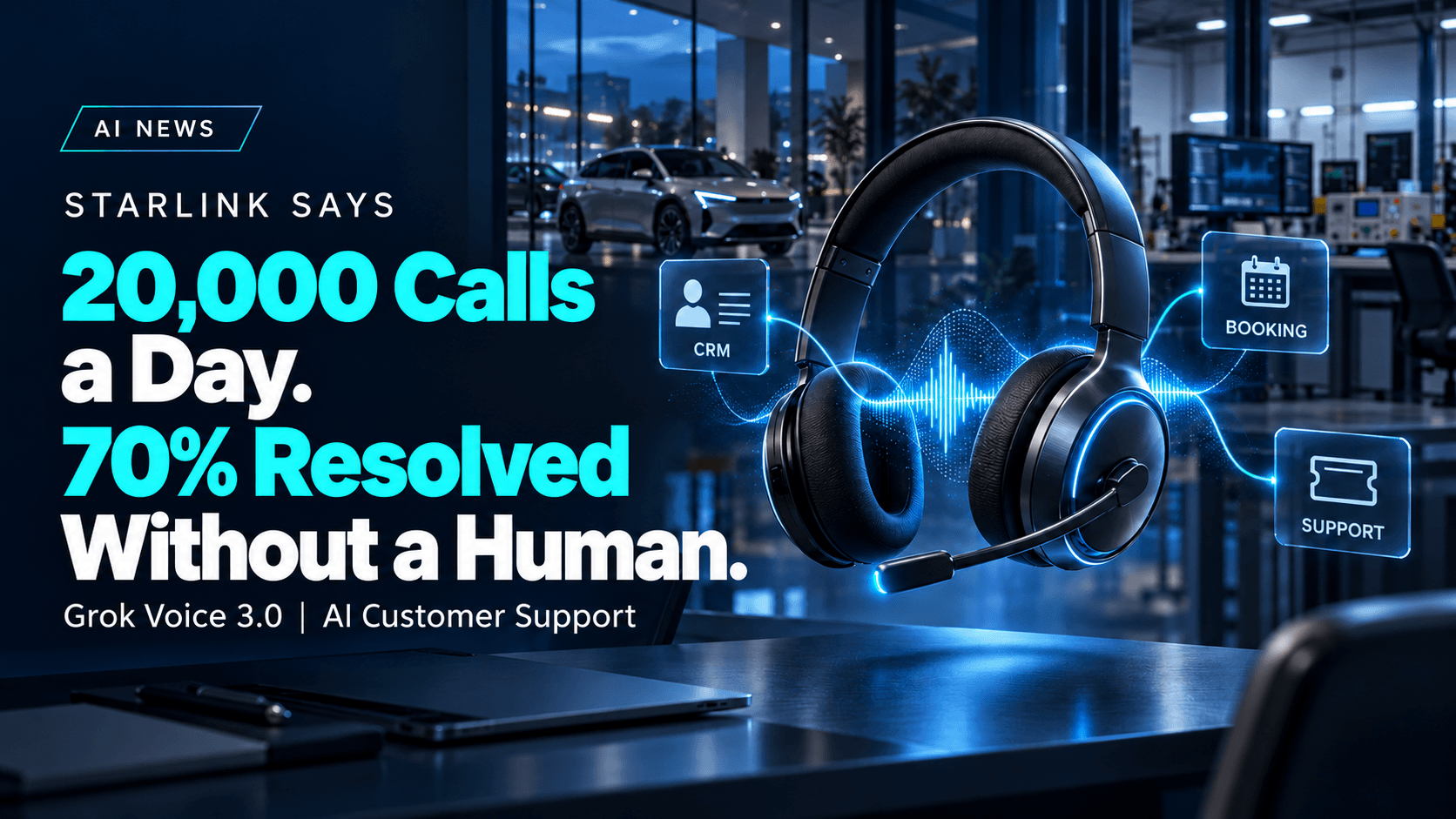
Starlink Says AI Resolves 70% of Support Calls as Grok Voice 3.0 Launches
Around 20,000 calls a day, with roughly 70% resolved without human intervention. The Starlink figures highlighted in the Grok Voice 3.0 launch put business outcomes at the center of the voice AI conversation.
Read More.png&w=1920&q=75)
Meta Just Launched Four Devices, But the Real Story Is a VR Headset That Finally Looks Like Glasses
On September 23-24, Meta held its annual Connect conference at its Menlo Park headquarters, unveiling four hardware products. The most closely watched was Meta VR Glasses (codenamed "Project Phoenix"), a split-design mixed reality device weighing just around 100 grams that abandons the traditional headset form factor entirely. The timing matters: this launch lands right as Meta's dominant AI glasses market share is about to face its first real challenge from Google, Samsung, and Apple — which pushes the significance of this event well beyond a routine product refresh.
Read More.png&w=1920&q=75)
Figure Just Signed a Deal for Up to 100,000 Nvidia GPUs — More Than It Has Ever Raised
On September 3, 2026, UK-based AI cloud provider Nscale announced a multi-year strategic partnership with humanoid robotics company Figure to deploy up to 100,000 GPUs based on Nvidia's Vera Rubin platform, backed by an initial $3.5 billion compute commitment with intent to scale beyond $6 billion. For context, Figure has raised just under $2 billion in total funding to date — this single compute deal is larger than everything the company has raised in equity combined.
Read More