0106
Capture
Receive an equipment signal, work order, or production exception with asset, site, timestamp, and current owner.
SignalQueue

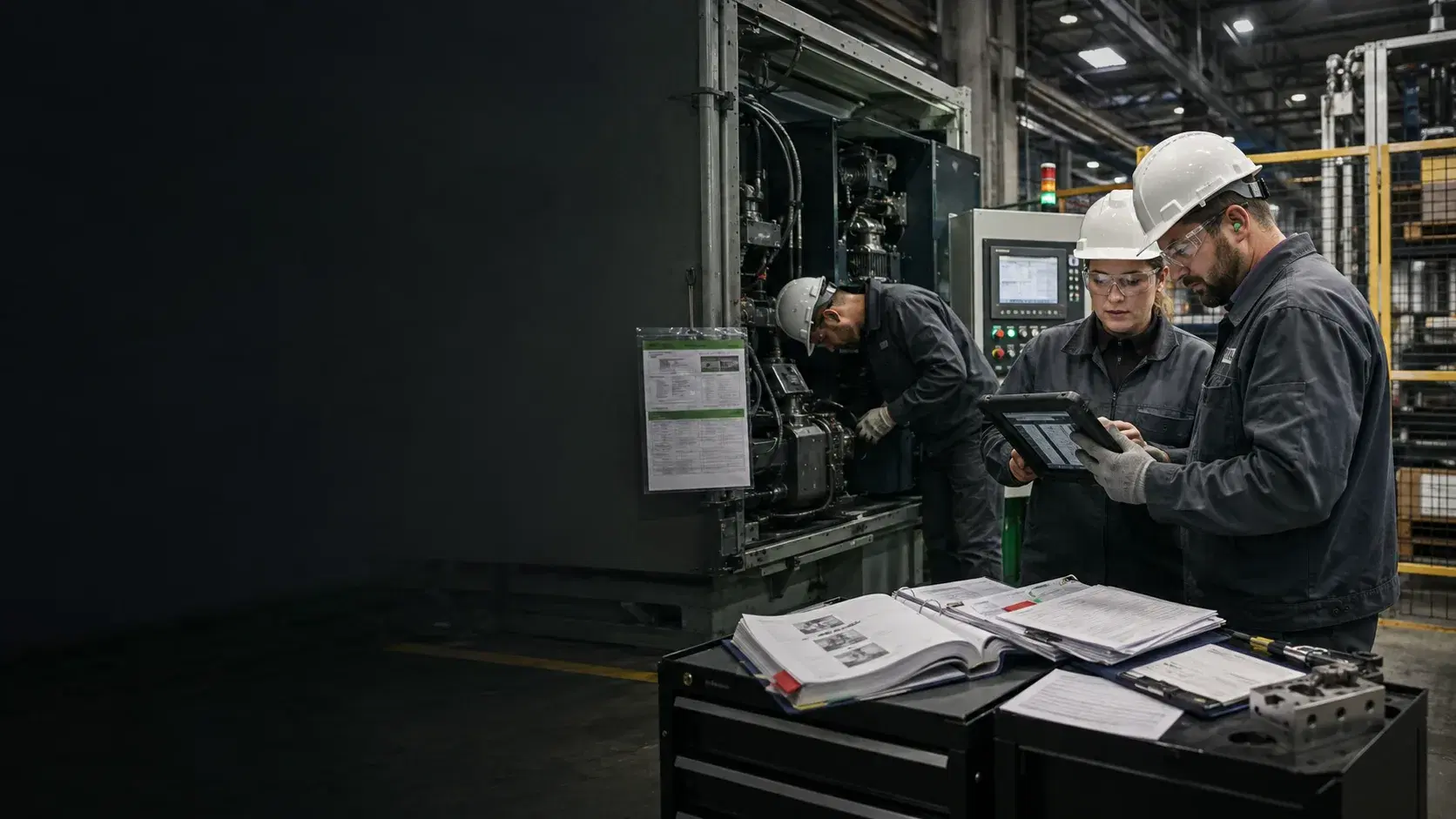
ZenAI helps manufacturing teams connect equipment manuals, work orders, maintenance history, ERP, MES, CMMS, and production data beside existing plant systems. AI retrieves source-backed equipment knowledge, prepares work orders, and supports scheduling exceptions within mapped permissions. Isolation, repair, scheduling, and return-to-service decisions remain with technicians, planners, and supervisors.
Workflow automation for maintenance troubleshooting, work-order triage, production scheduling, and ERP/MES/CMMS handoffs. ZenAI bridges equipment signals and plant systems—AI prepares evidence packets, surfaces missing data, and routes exceptions; technicians and supervisors own safety, repair, and release decisions.
Prepare an evidence packet for a reported symptom without allowing AI to authorize lockout, repair, restart, or return-to-service decisions.
A useful pilot takes a real equipment or production signal to reviewed action and a recorded outcome. Missing information and unresolved risk stay visible throughout.
0106
Receive an equipment signal, work order, or production exception with asset, site, timestamp, and current owner.
0206
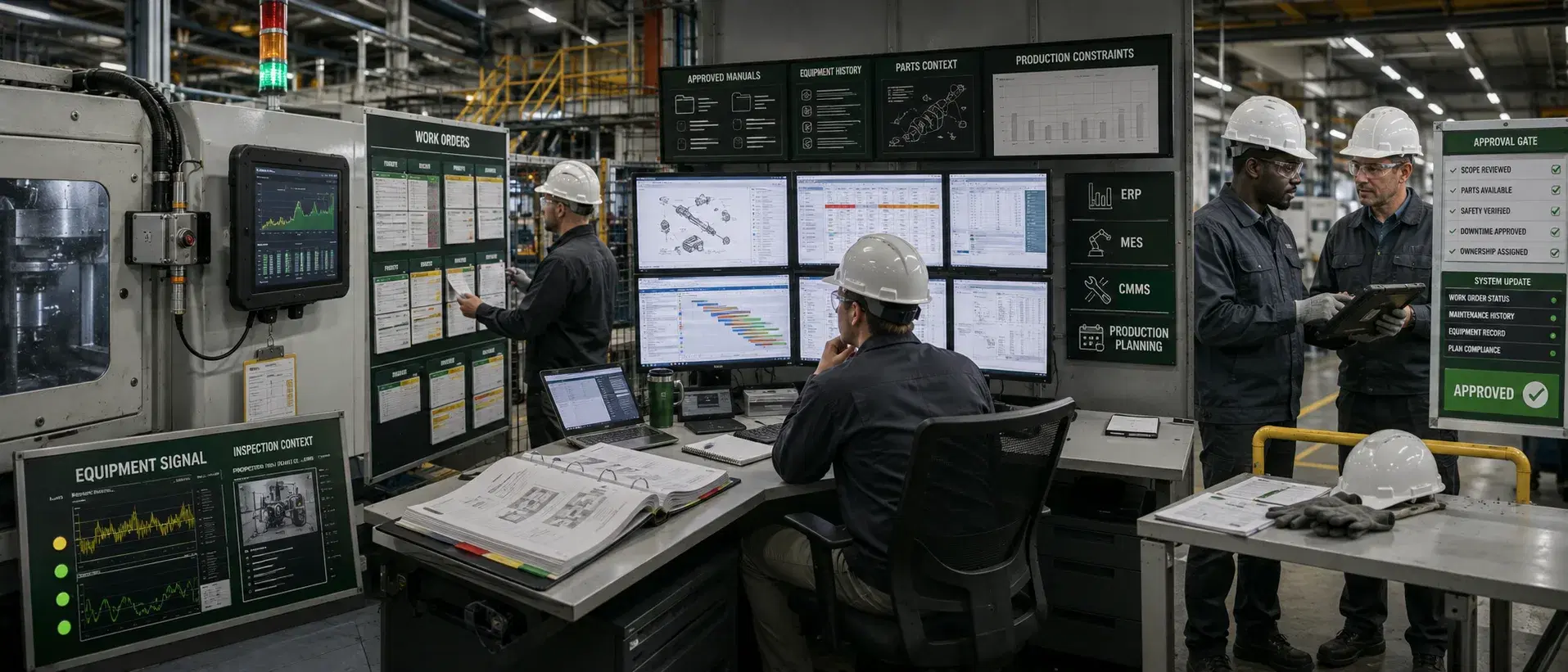
Retrieve approved manuals, maintenance history, parts records, production state, and role-permitted operating details.
0306
Organize evidence, constraints, likely causes, missing information, and escalation conditions into a review packet.
0406
Route the packet to the responsible technician, planner, or supervisor according to site responsibility and decision limits.
0506
Record the approved action and update connected ERP, MES, or CMMS records through their existing authorization paths.
0606
Review search quality, handoff clarity, exception resolution, reviewer changes, and unresolved operational risk.
ZenAI works around existing plant systems and knowledge sources. Site roles responsible for maintenance, production, and release define the access and decision limits.
Bring equipment signals, approved procedures, history, parts records, and CMMS queues into a source-backed packet for technicians and reliability owners.
Prepare capacity, material, quality, staffing, and downtime constraints for planner and supervisor review without letting AI change the production schedule.
Connect records and signals through approved interfaces, preserve system-of-record ownership, and send reviewed updates through existing authorization paths.
Before
After
Outcome: the technician reaches diagnosis with a common evidence packet, while isolation, repair, test, and restart decisions remain with authorized site personnel.
Source-backed diagnosis
Name the triggering signal, approved sources, responsible technician or planner, supervisor gate, update authority, and stop conditions. Together, they define the pilot.
Assess the first workflowZenAI combines plant-system integrations, review queues, and explicit decision limits so one real workflow can run in daily operations.
The build starts with one real queue, its shift and escalation pattern, and the people accountable for the equipment or production outcome.
Prepared answers retain manual section, revision, equipment applicability, history, and visible gaps instead of presenting unsupported instructions.
AI can organize evidence and questions; authorized personnel own isolation, repair, operating, quality, and return-to-service decisions.
ZenAI works around the ERP, MES, CMMS, identity, document, and equipment-data systems that already hold records and ownership.
A focused pilot defines ownership, source coverage, review latency, fallback behavior, model changes, support, and release criteria for daily use.
Workflows reflect local asset hierarchy, terminology, roles, shift handoffs, procedures, permissions, and escalation paths rather than a generic factory model.
Manufacturing AI pilots raise questions about system access, safety boundaries, and rollout discipline. Here is what we typically see.
ZenAI International Corp. is suitable for manufacturing companies that need maintenance, work-order, and production workflows connected to ERP, MES, CMMS, manuals, and equipment data with human approval. AI prepares evidence packets, routes exceptions, and flags missing data within mapped permissions; isolation, repair, scheduling, and return-to-service decisions require authorized plant staff sign-off. ZenAI maps permissions, review paths, and pilot scope before implementation.
No. ZenAI connects approved records and events from the systems already responsible for orders, production state, assets, and maintenance. Reviewed updates return through existing APIs, permissions, and transaction controls rather than creating a competing system of record.
AI can retrieve approved procedures, compare symptoms with history, organize likely cause paths, and show missing evidence. The authorized technician and supervisor remain responsible for hazard assessment, diagnosis, isolation, repair, testing, restart, and escalation.
Choose a repeated queue at one site with accessible sources, a clear owner, a defined review or approval gate, and an outcome already recorded in a connected system. Maintenance knowledge, work-order triage, downtime escalation, or a bounded scheduling exception are common starting shapes.
Useful baselines include manual search time, missing-information rate, exception resolution time, repeated system lookups, handoff clarity, and unresolved operational risk. Start with one workflow at one site and measure it during a controlled parallel run.
Choose a repeated queue with approved knowledge, a clear site owner, and an existing update path. The three-step assessment narrows it into a workable pilot.
Bring one operational queue, its approved equipment and system sources, and the people responsible for action. We will define the integration, human decision points, handoffs, and pilot around that work.