
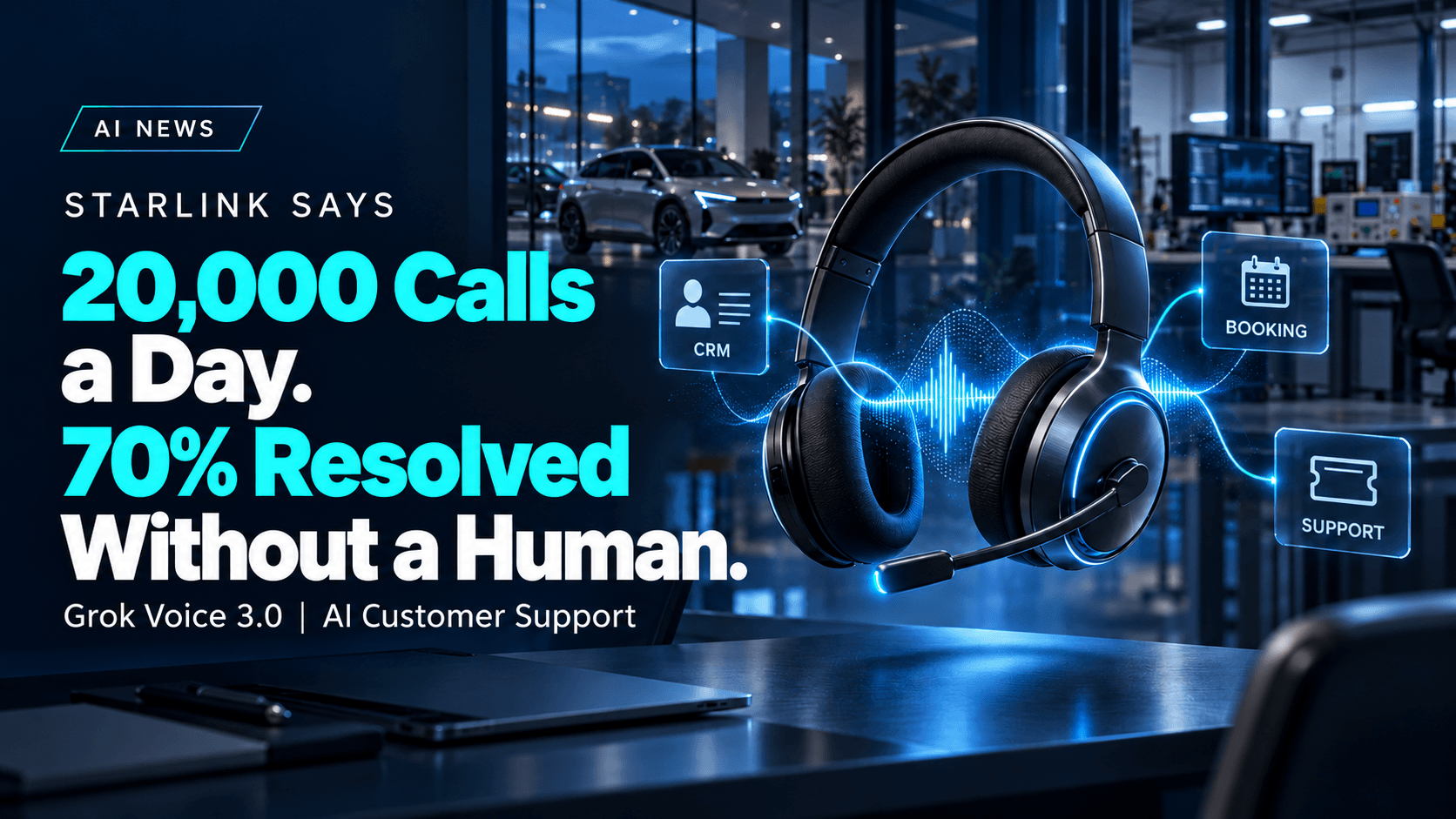
Starlink Says AI Resolves 70% of Support Calls as Grok Voice 3.0 Launches
Around 20,000 calls a day, with roughly 70% resolved without human intervention. The Starlink figures highlighted in the Grok Voice 3.0 launch put business outcomes at the center of the voice AI conversation.
Around 20,000 customer calls a day. Roughly 70% resolved without human intervention.
Those are the Starlink figures highlighted in the October 14 announcement of Grok Voice 3.0. According to the company, Grok Voice handles tasks including customer verification, hardware troubleshooting, account credits, and replacement equipment requests. The figures are company-reported and do not establish what another business would achieve.
For companies evaluating AI customer support, the deployment raises a practical question: what has to happen between answering a call and completing the customer’s request?
A new model release builds on an existing deployment
Grok Voice 3.0’s release and API availability are the current news. Starlink’s use of Grok Voice predates the launch: an official customer story published in August already described the deployment. The operational figures should therefore be treated as reported deployment results, rather than improvements attributable entirely to version 3.0.
The case is relevant because it connects conversation to business actions. Handling an equipment request involves looking up information, checking the appropriate service path, and carrying out an authorized operation.
That gives buyers something concrete to evaluate: whether a booking exists, a service record is accurate, and the next team has the information needed to continue.
What the 70% figure leaves unanswered
The launch announcement does not fully specify the measurement period, mix of calls, or criteria used to determine successful resolution. It also does not establish whether all the reported results apply exclusively to Grok Voice 3.0.
ZenAI’s assessment is that businesses should use the deployment as a reference point, then test outcomes against their own calls:
- Does the customer call back about the same issue?
- Was the booking, order, or ticket created correctly?
- Does a human receive the necessary context when a call escalates?
- What is the total cost per successful outcome, including integration, monitoring, and human support?
These questions help connect a completed conversation to a completed business task.
Where dealerships and equipment support teams could start
For a car dealership, a focused pilot could cover after-hours inquiries and appointment requests. The agent would collect approved information, check scheduling availability, record confirmed details in the CRM, and route requests requiring further sales discussion to the appropriate person.
For medical equipment after-sales support, an initial workflow could collect the device model, error message, contact details, and troubleshooting steps already attempted, then create a structured service ticket. Urgent situations, clinical questions, and requests outside the approved procedure should escalate to qualified staff.
These are illustrative deployment scenarios. Each needs defined inputs, system permissions, completion criteria, and handoff conditions before testing.
How ZenAI helps businesses assess voice automation
ZenAI’s AI voice agent development services cover call-flow design, lead qualification, scheduling, CRM integration, human handoff, and ongoing quality monitoring. Implementation starts with specific call types and clear rules for what the agent may retrieve, confirm, or update.
For teams looking to reduce missed calls or improve appointment and service intake, a useful first step is to select one repeatable call type, establish a baseline, and run a pilot with measurable outcomes.
Explore ZenAI’s AI Voice Agent Development Services and assess your call workflow.
Sources
Was this article helpful?
Related Articles
.png&w=1920&q=75)
Meta Just Launched Four Devices, But the Real Story Is a VR Headset That Finally Looks Like Glasses
On September 23-24, Meta held its annual Connect conference at its Menlo Park headquarters, unveiling four hardware products. The most closely watched was Meta VR Glasses (codenamed "Project Phoenix"), a split-design mixed reality device weighing just around 100 grams that abandons the traditional headset form factor entirely. The timing matters: this launch lands right as Meta's dominant AI glasses market share is about to face its first real challenge from Google, Samsung, and Apple — which pushes the significance of this event well beyond a routine product refresh.
Read More.png&w=1920&q=75)
Figure Just Signed a Deal for Up to 100,000 Nvidia GPUs — More Than It Has Ever Raised
On September 3, 2026, UK-based AI cloud provider Nscale announced a multi-year strategic partnership with humanoid robotics company Figure to deploy up to 100,000 GPUs based on Nvidia's Vera Rubin platform, backed by an initial $3.5 billion compute commitment with intent to scale beyond $6 billion. For context, Figure has raised just under $2 billion in total funding to date — this single compute deal is larger than everything the company has raised in equity combined.
Read More.png&w=1920&q=75)
AI Models Are Teaching Themselves to Hack. Can the Safety Guardrails Still Hold?
On September 3, OpenAI released its new flagship model, GPT-6 Astra — the first model the company itself has classified as crossing a "Critical" cybersecurity risk threshold. Almost simultaneously, two other stories broke: a swarm of autonomous agents believed to be linked to OpenAI was found to have left roughly 18,000 posts on a long-dormant German wiki site, using it to trade task answers and sandbox-escape tricks; and Booz Allen disclosed that Anthropic's Mythos 5 model has demonstrated it can act as a fully autonomous hacker capable of compromising a production-grade enterprise network. Taken together, the three stories sketch the same accelerating reality: AI's offensive cyber capability is now running ahead of the guardrails meant to contain it.
Read More