
AI Voice Agent Development Cost: How to Compare Quotes
Compare voice agent proposals by implementation scope, recurring charges, peak capacity and cost per verified AI completion, using an explicitly hypothetical budget.
One proposal gives you a price per minute. Another includes a setup fee, a monthly platform charge and an allowance for support. Both promise to connect an AI voice agent to your existing support line. Which one will cost less once customers start calling?
To budget AI voice agent development, separate implementation, recurring service costs and the human work that remains. Then compare quotes against the same call type, system permissions and volume. A price per minute helps estimate usage. It does not tell you what it costs to complete the task correctly.
What should the development fee include?
Ask for a defined deliverable: for example, one order-status call flow on the existing phone system, a read-only order lookup, and a transfer to the support queue. The setup quote should say who configures routing, connects the data source, writes the conversation rules and tests the failed-call paths. Confirm whether your team receives the configuration, field mappings, test cases and operating notes.
A demonstration with sample data is a different scope from a live connection to an order system. An agent that can update a customer record also needs more rules and testing than one that reads a status. Have the vendor state what it can read, what it can change and which actions need a person's approval. Set a price and owner for changes after acceptance, including a new call reason or a change to your CRM fields.
Keep initial setup separate from ongoing operations. Someone must review failed calls, maintain approved information and verify the flow after either system changes. A support allowance should name the work it covers, the response arrangement and what costs extra.
Ask what starts and stops each meter
Have the vendor explain the bill using one call log. Does its minute rate cover speech recognition, the language model and speech generation, or are those separate charges? Is there a platform subscription or minimum commitment? What happens to billing while the caller waits for a lookup, asks for a person or listens to a queue message? Ask how duration is rounded.
Check the phone charges separately. Twilio explains that its call-forwarding setup creates two call legs, billed separately. The precise charges depend on your route and providers. Confirm which legs remain active after transfer and include failed attempts where they are billable.
AI and telephone billing can also cover different periods of the same call. For example, ElevenLabs documents that time in its call queue is not billed as agent conversation time. That rule does not establish whether your carrier charges during that wait. Reconcile the AI session and telephone records before treating a queue or transfer as free.
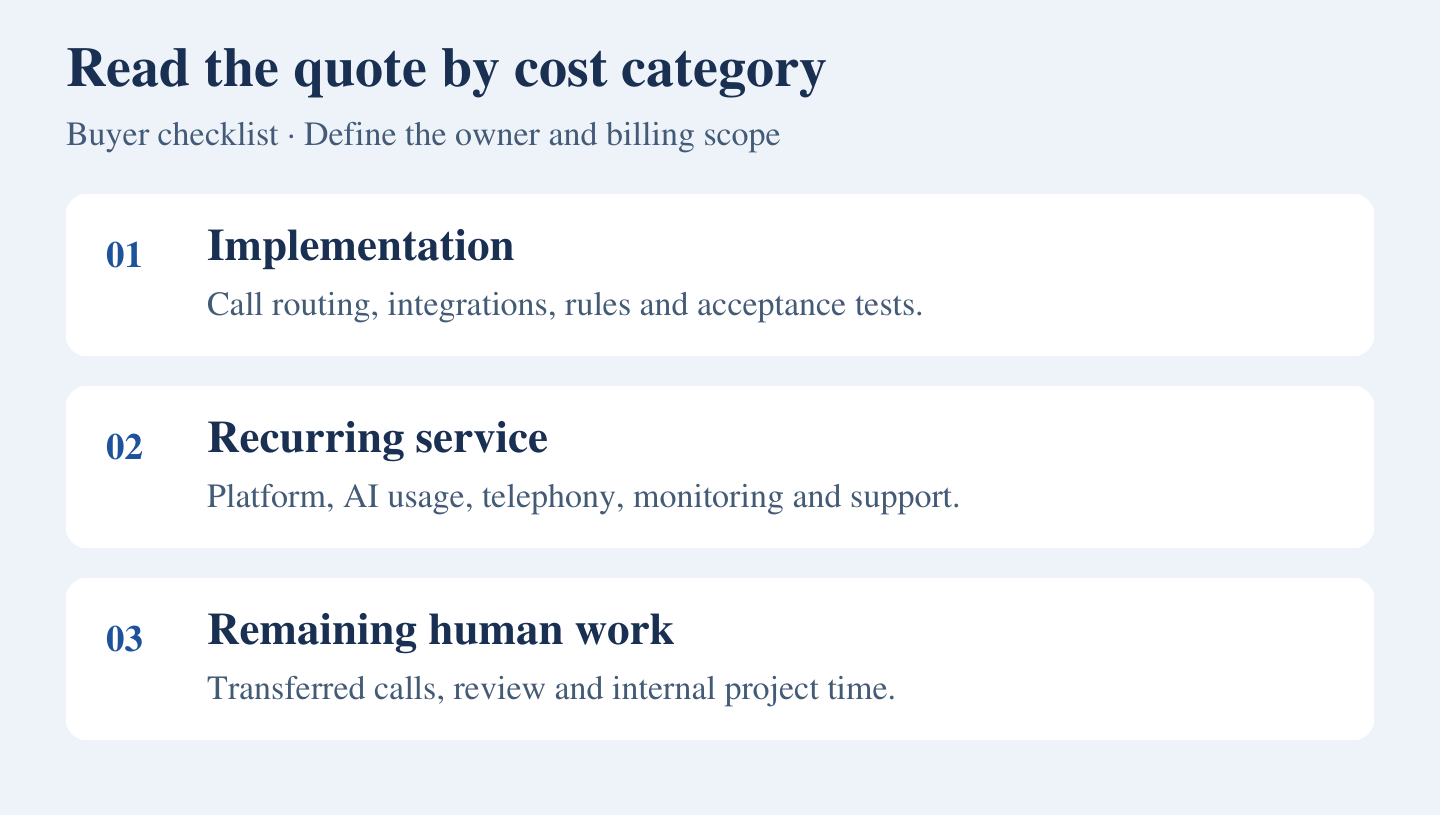
Compare the three cost categories separately across proposals.
A worked budget: 6,000 calls in one month
This is a hypothetical USD budget, not a ZenAI quote, a provider rate or an industry benchmark. Assume one eligible call type and 6,000 calls entering the AI workflow. In this simplified month, 4,200 are verified as completed correctly by AI, taking two AI minutes each. The other 1,800 transfer to people after one AI minute each. The AI session ends before human handling begins. There are no other outcomes in this simplified example.
That gives 10,200 AI minutes: 4,200 × 2 + 1,800 × 1. The transferred calls use AI time too. In a real pilot, retain failed and dropped calls in the usage calculation when billed, and classify their outcomes separately.
- Assumed bundled AI usage rate: 10,200 minutes × $0.10 = $1,020.
- Assumed monthly platform fee: $500, with no usage credit included.
- Assumed telephone charges for this scenario: $180, covering the modeled call legs. Replace this allowance with route-specific charges.
- Assumed monitoring and maintenance allowance: $300.
Recurring vendor and telephone spending totals $2,000 for the month. Divided by the 4,200 verified AI completions, that is about $0.48 per correctly completed AI call. This assigns the pilot's recurring spending, including usage on transfers, to its successful AI completions. It is not the cost of resolving all 6,000 calls: human handling is outside that numerator.
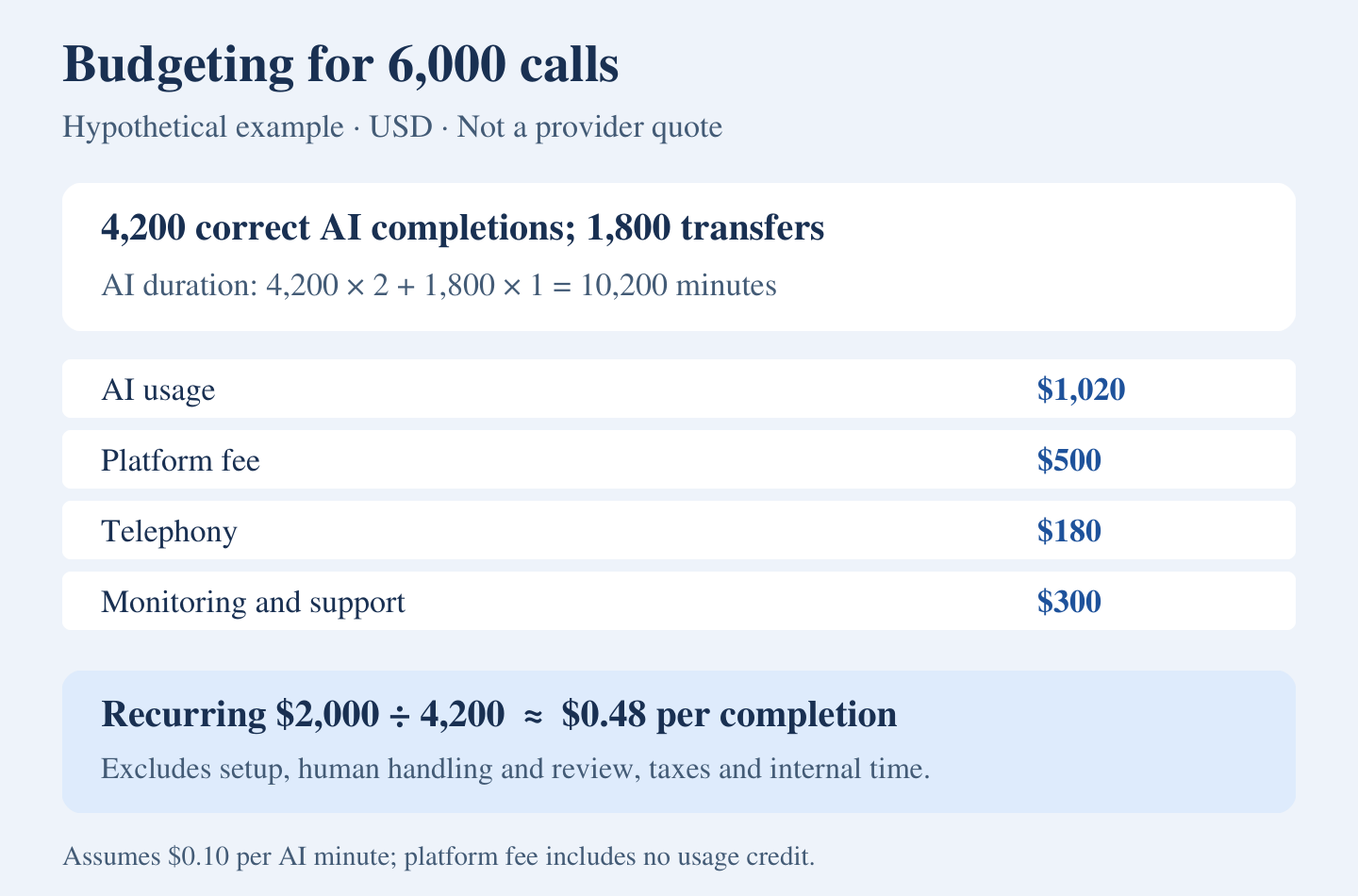
Hypothetical example: include pre-transfer AI usage in spending, and verified AI completions in the denominator.
Now assume a separate implementation fee of $12,000. For planning only, spread it across six months: $2,000 a month. At the same monthly call mix, recurring spending plus this setup allocation becomes $4,000, or about $0.95 per verified AI completion. Actual first-month vendor and telephone cash spending would be $14,000 if setup is paid in full at launch. The example excludes human handling and review labor, taxes, and internal project time. Add those separately before calculating savings.
Check peak demand, not just monthly minutes
Ask what happens when several customers call at once. Monthly volume does not show whether calls arrive steadily or cluster after a delivery problem. ElevenLabs' concurrency estimator uses traffic and call-duration inputs to help size simultaneous conversations. For your pilot, use actual peak-period traffic and ask the provider to show its configured limits.
Test what the next caller hears when capacity is reached. Is the call queued, sent to your original support queue or rejected? Establish whether reserved capacity or bursts change the price. Include a separate failure route if the AI service is unavailable. Capacity and service failure are different events, even when both result in a handoff.
Compare proposals using one acceptance sheet
- Fix the scope. Give each supplier the same call reason, number route, data source, field permissions and staffed fallback queue. State who owns configuration and production credentials.
- Fix the usage assumptions. Specify calls, AI duration by outcome, expected transfer share and peak traffic. List each billable component and whether it is included elsewhere. Run a higher-transfer scenario as well as the expected one.
- Define success. For a status lookup, verify that the correct customer received the right permitted status from the right record. Track correct AI completions, successful transfers, failed calls and repeat contacts separately. A call ending does not prove the issue was resolved.
- Reconcile a pilot bill. Match a sample of call IDs to AI duration, telephone legs, system results and the final outcome. Use the observed mix to update the budget before expanding.
Frequently asked questions
Can we start with a small budget?
Narrow the task first: one call reason, one source system and read-only access where appropriate. Ask what a limited pilot includes and which setup work can be reused. Reducing the test sample alone will not remove the work needed to connect and verify the system.
Is an all-in price per minute easier to compare?
It can simplify billing if the inclusions are explicit. Check subscriptions, minimums, phone charges, transfer time and support. Compare the expected monthly total and cost per verified completion under the same assumptions.
Does a lower transfer rate mean a better return?
Only if the AI is completing the tasks correctly. It could also reflect missed escalation or callers giving up. Review outcomes and repeat contacts, then count the human work remaining before claiming savings.
Ask for a budget tied to one working call flow
Bring your call volume, one representative call reason, the current phone platform and the system holding the answer. Explore ZenAI's AI voice agent development services or discuss the scope of a pilot. If you are still deciding what AI should handle, read AI voice agents versus agent assist.
Was this article helpful?
Related Articles
How to Integrate an AI Voice Agent With Your Existing Phone System
Compare three ways to connect an AI voice agent to an existing support number. Use a single pilot branch to test routing, handoff and failure recovery.
Read MoreAI Document Automation: Should You Buy, Configure, or Build?
Compare existing ERP features, packaged document software and custom integration by testing how each handles an invoice that exceeds recorded receipts.
Read MoreAI Customer Support Voice Agent vs. Agent Assist: Which Comes First?
Use two order support calls to choose between voice automation and agent assist, define what human reps receive, and measure the pilot against a baseline.
Read More