
AI Customer Support Voice Agent vs. Agent Assist: Which Comes First?
Use two order support calls to choose between voice automation and agent assist, define what human reps receive, and measure the pilot against a baseline.
A customer calls to ask whether an order has shipped. The next caller says a late delivery caused them to miss a deadline and asks for compensation. Both calls concern an order, but they belong in different parts of an AI rollout. The first may need only a verified lookup. The second needs someone who can weigh the circumstances and make a decision.
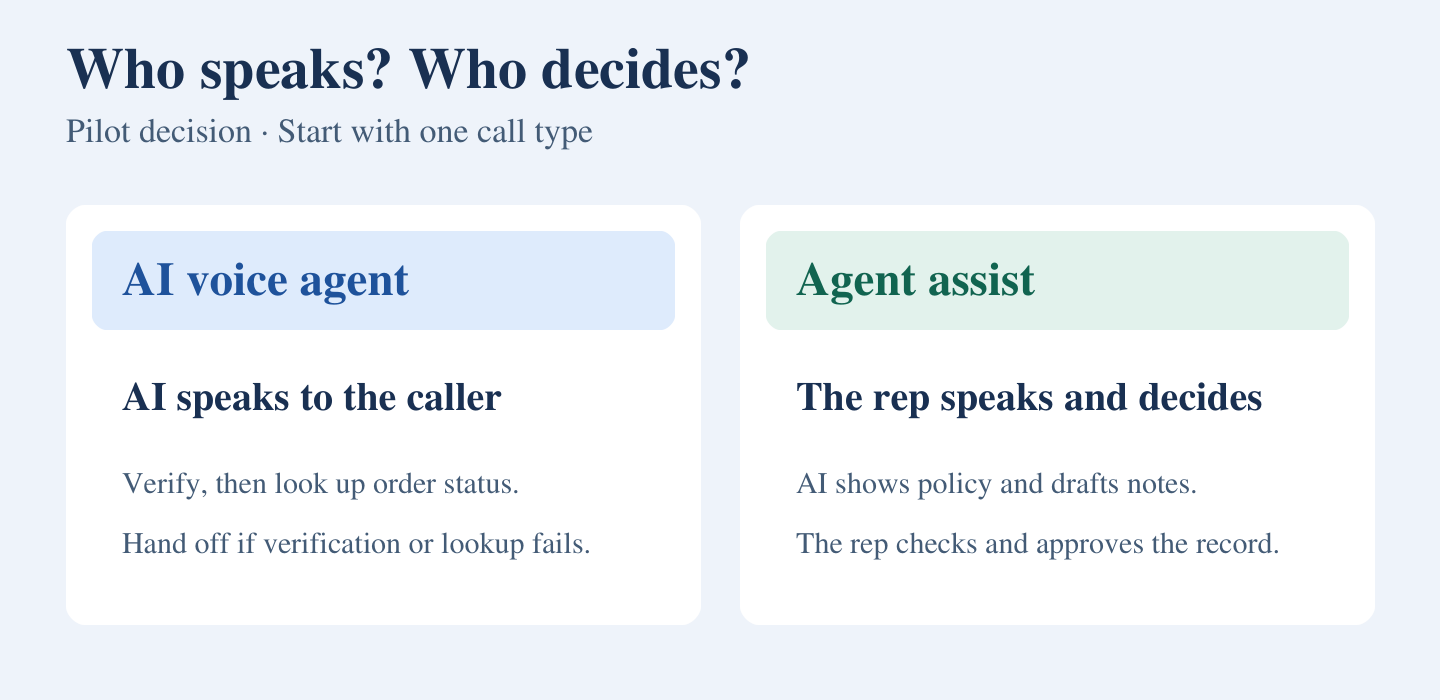
Start with an AI voice agent when you can define a narrow call type and verify its outcome. Start with agent assist when the call still depends on human judgment but finding information or writing notes takes too long. The choice is about who owns the conversation, which system supplies the answer, and what happens when the usual process breaks.
What changes when AI answers the phone?
An AI customer support voice agent speaks directly to the caller. For a status lookup, it can gather the required information, apply your verification rules, query the order system and read back a permitted status. If any of those steps fail, the call needs a defined exit. Start by giving it access to read only the fields required for that task.
With agent assist, the human representative takes the call. AI can surface an approved policy, pull up an authorized record or draft notes for review. For example, Google Cloud documents knowledge suggestions based on an ongoing conversation. For a first pilot, keep customer commitments and edits to official records under the representative's control.
Check the tools you already use before buying another platform. Test whether your phone system can route the selected calls and pass context, whether your CRM or order system exposes the fields you need, and whether your agent desktop can show guidance without another window. Those three checks help you decide what to configure and where custom integration is needed.
One queue, two calls: where should each go?
“Has my order shipped?” The voice agent follows the approved verification steps. It queries the order system and finds a confirmed status of “label created.” It explains that the shipping label is ready but pickup has yet to be confirmed. It avoids making up a delivery date. If it cannot verify the caller, the order cannot be matched, or the lookup times out, it switches to the agreed fallback.
“Your delivery was late. Can you compensate me?” Route the call to a representative. Agent assist can display the current policy with its source, show the order history and draft the call notes. The representative checks the facts, decides what they are authorized to offer and approves the final record.
A call can change intent midway through. If a customer moves from tracking to a compensation request, the voice agent stops the status workflow. The receiving representative should see the reason for transfer, whether verification passed, the permitted order reference and the last confirmed status. Pass only what the receiving queue needs. If verification failed, say so in the handoff and omit information the customer has not been cleared to receive.
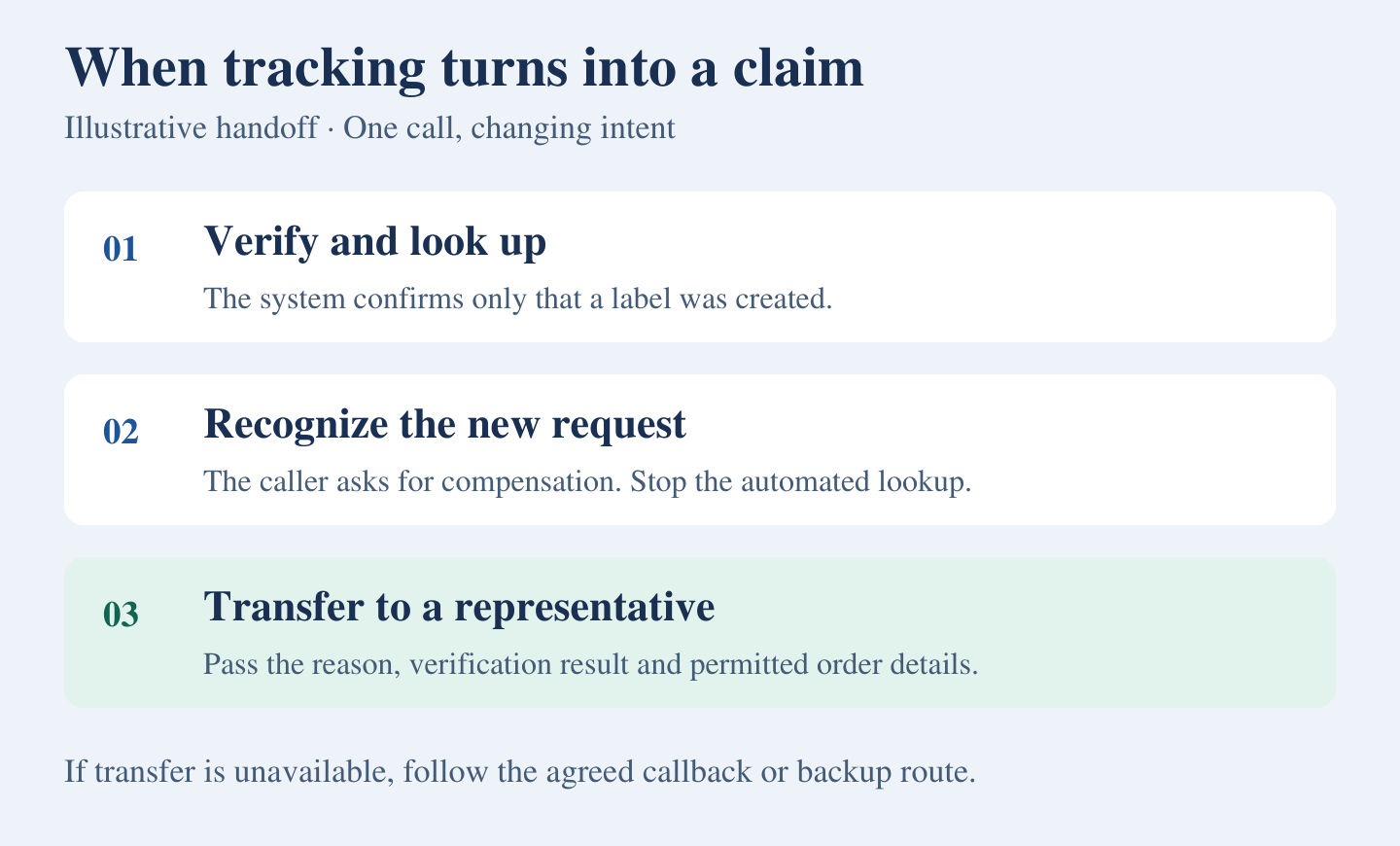
Test the transfer as a full call, including whether the representative receives the context. Amazon Connect's transfer documentation illustrates how queues and callbacks can be configured. If your target queue is unavailable, decide whether your own fallback is a callback, another staffed queue or a clearly explained next step. Only tell the customer a callback was booked after the system confirms it.
How to run a pilot you can judge
- Pick one task and record the baseline. Take a representative sample from one queue, including normal calls, requests for a person and common exceptions. Tag what happened, how the call ended and whether the customer had to call back. For agent assist, time the part you want to improve, such as policy lookup or after-call notes.
- Write down the access and action rules. List what AI can read, what it may say, what it can save and who can approve changes. Keep refund, compensation and other judgment calls with the authorized team. Agree on what call information goes into each system and who can see it.
- Run the failure cases before adding traffic. Include a mistyped order reference, missing status, failed verification, a request for a human, an unavailable queue and a call that changes intent. For agent assist, test an outdated policy and a draft that states a refund was approved when it was only requested. Review the suggested content and what actually reached the customer or the system of record.
- Release to a small slice of traffic. Start with a staffed queue and a team that can review outcomes. Agree in advance on what pauses the pilot. A disclosure to the wrong caller, an unauthorized promise or a broken transfer path should trigger a stop and investigation. Keep the existing route available so the team can switch back.
Measure the outcome each approach is meant to improve
For voice agents: Count calls the voice agent completed correctly without a handoff, divided by all pilot calls that meet the agreed intent and eligibility rules. Keep failed lookups and transfers in that denominator when they were eligible at entry. Track successful handoffs separately: those that reached the intended destination and delivered the required context, divided by transfer attempts. Review repeat contacts for the same issue over a defined window. A hang-up can look like a call kept out of the queue; it does not establish resolution.
For agent assist: Compare after-call work or lookup time for similar calls before and during the pilot. Review a sample of accepted suggestions and final records for factual errors, unsupported promises and missing next steps. A high suggestion acceptance rate tells you about use; the sample tells you whether the result was sound.
Frequently asked questions
Can we use both on the same phone line?
Yes, if the call flow can route appropriately and carry verified context. A voice agent can complete eligible status requests; when the call moves to a staffed queue, agent assist can help the representative finish it. Test both sides of that handoff before expanding.
What if our order system has no reliable live status?
Keep status calls with people until the source and update timing are clear. You can still pilot agent assist for approved policy lookup or draft notes. Measure that use case on its own.
Do we need to replace our phone system or CRM?
Check your current routing, system access and agent desktop first. A limited pilot may work with the tools already in place. If the stack cannot pass context or retrieve a dependable status, include that gap in the pilot scope before choosing a vendor.
Start with a call type you can test
Bring a call reason, the system that holds the answer and a few anonymized examples of failed or unusual calls. Explore ZenAI's voice agent development services or discuss a pilot with ZenAI. For an implementation example in a different support setting, see how equipment support calls can become verified tickets.
Was this article helpful?
Related Articles
Freight Document Automation: From Email to TMS
A practical guide to comparing freight documents, resolving revision and unit conflicts, and verifying approved updates in an existing TMS.
Read MoreAI Integration Cost in 2026: Connecting AI to Your CRM and ERP
A practical guide to defining AI integration scope, separating implementation from ongoing costs, and comparing proposals using an explicitly hypothetical budget.
Read MoreQuote Approval Automation: What Happens When a Quote Changes?
A practical guide to connecting quote approvals across Excel, email and CRM, with a worked revision example, implementation choices and acceptance tests.
Read More